
Bipolaris blight of cereals
Bipolaris cynodontis
The disease is caused by the asexual fungus Bipolaris cynodontis (teleomorph Cochliobolus cynodontis), which belongs to the class Hyphomycetes. This pathogen is a specialized agent of helminthosporium leaf spots, primarily affecting various cereal species and grasses.
What the section contains
Bipolaris blight of cereals
The fungus survives in soil, on crop residues, and within seed lots as mycelium and conidia. Primary infection of crops occurs through the dissemination of conidia via wind, rain splashes, or insect vectors during the growing season.
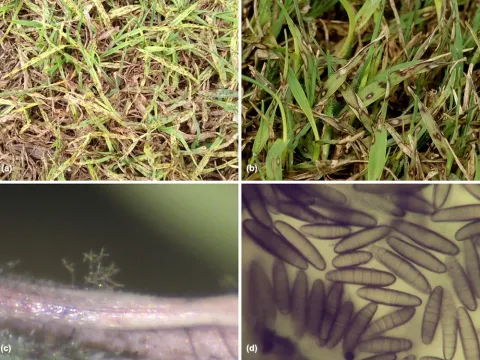
The fungal conidiophores are erect, olive-brown, and produce multicellular, ellipsoidal conidia. The pathogen exhibits high reproductive efficiency, enabling it to spread rapidly under conducive environmental conditions.
The biological cycle involves spore germination, penetration of host tissues through stomata or mechanical injuries, and subsequent colonization of the leaf parenchyma, leading to localized necrosis.
The pathogen is highly dependent on leaf wetness, making it a classic disease of high-humidity periods. Its incubation period can be as short as a few days under optimal temperature and moisture levels.
Initial symptoms appear as small chlorotic spots that gradually turn brown or dark brown. These spots are typically elongated, running parallel to the leaf veins, a common characteristic of helminthosporium diseases.
The center of the lesions often becomes light tan or straw-colored, typically surrounded by a yellow halo. Under high humidity, an olive-black velvety mycelial growth may appear on the necrotic areas.
Infection can spread from leaves to leaf sheaths, stems, and in severe cases, the spikelets. Heavy infestation often results in the premature senescence and death of lower leaves, significantly reducing the green surface area.
The disease often manifests in patches throughout the field, particularly in low-lying areas where dew or rain collects. If the infection reaches the ear, it can cause darkening of the glumes and shriveled grains.
Field-level observation shows that the disease progresses from the lower canopy upwards, potentially covering the entire foliage if the environment remains favorable for the fungus.
The development of Bipolaris blight is primarily driven by high relative humidity (above 80-85%) and the presence of free water on leaf surfaces. Prolonged wet periods significantly enhance infection rates.
The optimal temperature range for the growth and conidial production of Bipolaris cynodontis is +22 °C to +28 °C. At these temperatures, the pathogen's metabolic activity is maximized.
Dense crop stands create a microclimate with restricted airflow, trapping moisture within the lower canopy and promoting infection spread. This environment is highly conducive to disease establishment.
Monoculture and inadequate management of crop debris are significant factors that maintain high inoculum levels in the soil, leading to recurring outbreaks in subsequent seasons.
Imbalanced nutrient management, particularly excessive nitrogen fertilization, can result in succulent growth that is more susceptible to colonization by the fungal pathogen.
The primary economic impact of Bipolaris blight is a reduction in crop yield caused by the destruction of photosynthetic tissue. This leads to diminished grain filling and reduced biomass production.
Severe infection results in smaller, shriveled grains, decreasing the 1000-grain weight and overall grain quality. Furthermore, contaminated seeds may exhibit reduced germination and act as a carrier for the pathogen to new fields.
Plants affected by the disease are often more susceptible to secondary stressors, such as drought or heat, which further compounds the potential yield loss.
Economic losses arise not only from direct yield reduction but also from the high costs associated with fungicide applications and post-harvest cleaning required for low-quality grain.
In regions with high annual rainfall, Bipolaris blight can lead to substantial reductions in harvestable quantity, necessitating strict adherence to integrated pest management (IPM) practices.
Effective management requires an integrated approach, including cultural practices and chemical intervention. Crop rotation is essential to break the life cycle of the pathogen, ideally avoiding susceptible cereals for at least two to three years.
Management of crop residues through deep plowing or burning (where permitted) helps reduce the primary inoculum source in the soil. Promoting the rapid decomposition of residues is key to minimizing fungal survival.
Seed treatment with systemic fungicides is a crucial proactive step to protect seedlings from early-stage infection and ensure uniform stand establishment.
Fungicide sprays utilizing triazoles or strobilurins are effective if applied upon the detection of initial disease symptoms or based on infection risk modeling during critical growth stages.
- Utilize resistant or tolerant cultivars to minimize pathogen pressure.
- Maintain balanced soil fertility, emphasizing phosphorus and potassium to boost plant immunity.
- Control grassy weeds which serve as alternate hosts during the off-season.
- Optimize seeding rates to improve canopy ventilation and reduce moisture accumulation.