
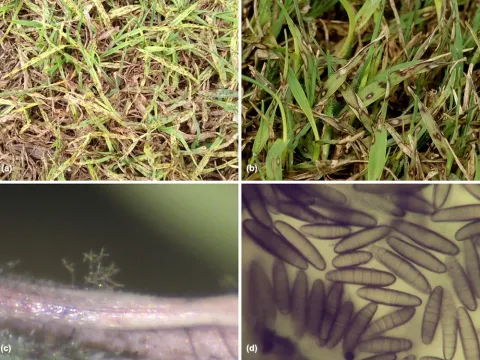
Bipolaris chloridis
Bipolaris chloridis
The causal agent of this disease is the microscopic fungus Bipolaris chloridis, which belongs to the class Ascomycetes. It is a well-known pathogen capable of causing helminthosporium leaf spots on a wide variety of crop species.
What the section contains
Bipolaris chloridis
This fungus produces conidia, which serve as the primary inoculum for infection during the growing season. The mycelium can persist for extended periods in crop debris, soil, and seed material, ensuring its survival during adverse conditions.
The life cycle of the fungus is closely linked to climatic conditions that facilitate the rapid dispersal of spores via air currents. The aggressiveness of the pathogen depends heavily on the genetic susceptibility of the host variety and local environmental triggers.
As a facultative parasite, the fungus can live on both living tissues of the host and saprophytically on dead organic matter. This dual strategy makes the pathogen particularly resilient and difficult to eradicate from agricultural fields.
Morphologically, Bipolaris chloridis is identified by its dark-colored, multi-cellular conidia. These spores are easily detached and carried by wind or rain splashes onto healthy plant leaves, initiating a new infection cycle.
The initial symptoms manifest as chlorotic spots that eventually turn into necrotic lesions. A characteristic feature is the appearance of elongated or circular spots with a dark border, often accompanied by yellowing of the surrounding tissue.
Under conditions of high humidity, an olive-black mold develops on the surface of the lesions, representing the fungal sporulation. This visual sign is a key diagnostic marker for identifying Bipolaris chloridis in the field.
As the disease progresses, lesions can merge and cover significant areas of the leaf surface. This leads to premature senescence of the foliage, drastically reducing the photosynthetic capacity of the plant.
In addition to leaves, the pathogen can affect stems and reproductive organs like panicles or ears. On stems, dark streaks may form, which can lead to weakened stalks and potential lodging during heavy rainfall or wind.
During the final stages of the infection, affected tissues become brittle and fragile. Misdiagnosis in the early stages often leads to the symptoms being mistaken for natural aging or nutrient deficiencies in the crop.
For Bipolaris chloridis to thrive, long periods of high humidity (above 85-90%) are required. Frequent rainfall during active growth stages provides the perfect environment for spores to germinate on the leaf surfaces.
The optimal temperature range for the development of the fungus is between +22 and +28 degrees Celsius. Intense disease outbreaks in cereal fields are most frequently observed when these thermal conditions coincide with wet weather.
Failure to implement a proper crop rotation strategy is a primary factor in the buildup of inoculum in the soil. Re-cropping susceptible varieties in the same field significantly increases the risk of an epidemic.
Dense crop stands, which restrict air circulation, create a microclimate with trapped moisture. This lack of airflow prevents foliage from drying quickly after dew or rain, creating an ideal habitat for the fungus.
Nutrient imbalances, particularly potassium deficiency, weaken the plant's natural immune system. Agronomic mistakes during the cultivation process often correlate directly with the severity of the fungal infection.
The harmfulness of the disease lies in the substantial reduction of the leaf surface area available for assimilation, which leads to a sharp decrease in yield. Plants redirect energy toward defense and repair instead of grain development.
Damage to the ear or panicle structures directly affects grain weight and overall quality. Infected grain is often shriveled, exhibits poor seed germination rates, and may have lower protein and gluten content.
Massive spread of the infection can lead to the death of most leaves before the grain filling stage is complete. Consequently, yield losses can range between 20% and 40%, depending on the intensity of the outbreak.
Compromised plant tissues serve as entry points for secondary infections, further degrading the health of the crop. Moreover, the fungus may produce mycotoxins, which can render the harvested product unsafe for animal feed.
Economic damage stems from both direct yield losses and the high costs associated with additional fungicide applications. In critical years, the disease can make the production of certain susceptible varieties economically unviable.
The primary control measure involves the use of resistant varieties and hybrids capable of limiting the development of the fungus. Selecting certified, high-quality seeds is the first step toward securing a healthy harvest.
Strict adherence to crop rotation helps break the cycle of infection. Returning a susceptible crop to the same field should be avoided for at least 3-4 years to allow the pathogen to lose its viability in the soil.
Efficient incorporation of crop residues into the soil accelerates their decomposition, which eliminates the substrate necessary for the fungus to survive. Deep plowing effectively reduces the infectious background on the field surface.
The application of preventative and curative fungicides is effective during periods of high disease pressure. The timing of treatments should be guided by regular phytosanitary monitoring of the fields.
- Seed treatment with registered broad-spectrum fungicides.
- Timely application of potash fertilizers to boost plant immunity.
- Management of weed populations that act as alternate hosts.
- Optimizing seeding rates to improve crop ventilation.
- Monitoring field edges and hot spots for early detection of symptoms.