
Baeomyces rufus
Baeomyces rufus
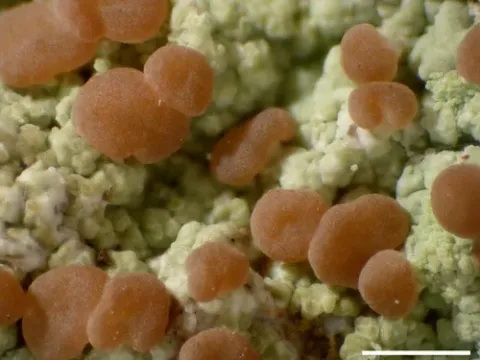
Baeomyces rufus is a ground-dwelling lichen that forms distinct granular or crustose thalli on the soil surface. Its appearance is characterized by a grey-greenish color that can cover significant patches of ground.
What the section contains
Baeomyces rufus
The diagnostic feature of this organism is its fruiting bodies, known as apothecia. These are reddish-brown, mushroom-shaped structures sitting on short stalks, making them clearly visible against the substrate.
This lichen is typically found on bare, undisturbed soil, sandy banks, or loamy surfaces. It does not penetrate the host tissue, distinguishing it from parasitic plant diseases.
Visual identification in a field involves noticing persistent patches that do not wither like annual weeds. The thallus is structurally complex and distinct from fungal mycelium.
Proper identification is crucial, as the presence of this lichen is often confused with fungal infections, despite their fundamentally different biological nature.
Baeomyces rufus is a lichen, a symbiotic association between a fungus (the mycobiont) and algae (the photobiont). It is not a plant pathogen in the strict sense and does not infect crops.
The biology of the organism relies on photosynthesis and moisture absorption from the air. It does not feed on plant sap or internal tissues, nor does it excrete plant-pathogenic toxins.
Spread occurs through the dispersal of spores produced in apothecia, as well as vegetative propagation via thallus fragmentation. Wind and water are the primary agents of dispersal.
The development cycle of this organism is exceptionally slow, meaning its presence indicates an area that has been left unmanaged or undisturbed for a significant period.
While it belongs to the kingdom Fungi, it does not possess the pathogenic mechanisms required to cause disease in agricultural crops.
Growth of Baeomyces rufus is favored by stable moisture levels on the soil surface and a lack of mechanical disturbance. It prefers acidic, nutrient-poor soil environments.
Shaded areas that remain damp for extended periods provide an optimal microclimate for this lichen to thrive and expand its thallus coverage.
Intensive agricultural practices, particularly deep plowing and cultivation, are the primary limiting factors that prevent the establishment of this organism.
Competition from fast-growing weeds and crops usually inhibits the development of the lichen, as it cannot compete for light and space in a dense canopy.
Low soil fertility and lack of structural aeration contribute to the conditions under which Baeomyces rufus can become a surface-dominant organism.
Baeomyces rufus causes no direct parasitic damage to crops. However, it can create a physical crust on the soil that inhibits proper aeration and water infiltration.
The presence of a thick lichen crust may mechanically impede seed germination, particularly for small-seeded crops that struggle to break through the surface layer.
By retaining moisture on the soil surface, the lichen may create a microenvironment conducive to the secondary growth of other harmful fungi or bacterial rots.
Its presence is primarily an indicator of soil degradation, nutrient deficiency, or a long-term failure to implement standard soil management practices.
While not a direct threat to yield, its expansion suggests that the field is not being utilized at its full agricultural potential.
The most effective management strategy is regular mechanical soil disturbance. Plowing, harrowing, and cultivation effectively break the thallus and prevent its regrowth.
Amending acidic soils with lime can significantly alter the soil chemistry, making it unfavorable for the colonization of Baeomyces rufus.
Boosting soil fertility through the appropriate application of fertilizers ensures robust crop growth, which naturally suppresses the lichen by shading the soil surface.
Chemical fungicides are unnecessary and generally ineffective, as the lichen is not a pathogenic fungus and does not respond to standard plant disease control products.
Proactive management includes implementing consistent crop rotations and ensuring that fields are not left in a fallow state without proper maintenance or weed control.