
Baeospora
Baeospora
The genus Baeospora refers to saprotrophic fungi that typically inhabit decaying plant matter, most notably conifer cones.
What the section contains
Baeospora
The primary species is Baeospora myosura, which acts as a decomposer within forest ecosystems by breaking down woody tissues.
These fungi belong to the Marasmiaceae family and possess unique enzymatic pathways for nutrient absorption from plant debris.
Baeospora is not a primary pathogen of agricultural crops but is ecologically significant in forest and nursery environments.
The mycelium of the fungus is highly adapted to colonizing tough lignified substrates found in needles and pine or spruce cones.
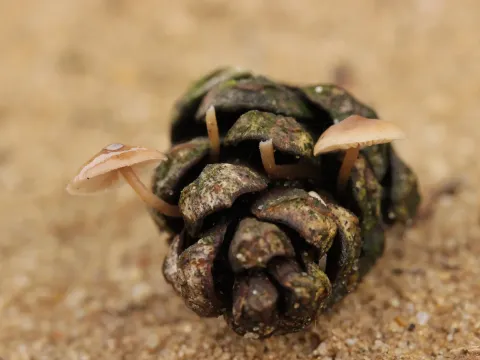
The most visible sign of Baeospora is the emergence of small mushroom fruit bodies on decaying conifer cones.
The caps are typically pale brownish or grayish, with very crowded, thin gills underneath, which is a key diagnostic feature.
The stems are often tough, fibrous, and covered in fine, downy hairs that secure the mushroom to the cone scales.
Initial colonization by the fungus appears as a fine, white or grayish network of mycelium coating the surface of the debris.
In mature stages, the fruiting bodies form dense clusters on the surface of the cone, signaling complete colonization.
Baeospora development is heavily dependent on high moisture levels and the presence of abundant conifer needle and cone litter.
The fungus thrives in cool, damp conditions, typically manifesting its fruiting bodies during the autumn months.
Acidic soil environments are preferred by the fungus, as these conditions often lack competitive microorganisms that would otherwise limit it.
Shaded, sheltered areas with minimal air movement promote the high humidity required for sporulation and mycelial growth.
The availability of year-old fallen cones provides the ideal substrate density for the life cycle of the Baeospora genus.
Baeospora is largely benign regarding live agricultural crops and is primarily observed as a decomposer of organic waste.
Potential issues may arise in tree nurseries if fungal abundance becomes too high, potentially affecting the soil microbial balance.
Rapid decomposition of organic matter can alter the local soil nutrient profile, which may be undesirable in specific nursery setups.
The fungus is generally considered a beneficial element of forest ecology but can be viewed as a nuisance in clean-cultivation practices.
No direct economic damage to field crops has been documented, as Baeospora occupies a strictly saprotrophic niche.
Management focuses on sanitation, specifically the regular removal of conifer litter and old cones from nursery environments.
Improving soil drainage is essential to reduce the localized humidity levels that trigger mushroom development.
Maintaining proper spacing between nursery beds helps to facilitate airflow and reduce the build-up of moist organic debris.
Adjusting soil pH can help create an environment less favorable to the rapid proliferation of saprotrophic fungi like Baeospora.
While chemical fungicides are available, their use is rarely required, as cultural management techniques are highly effective.