
Baeomyces
Baeomyces
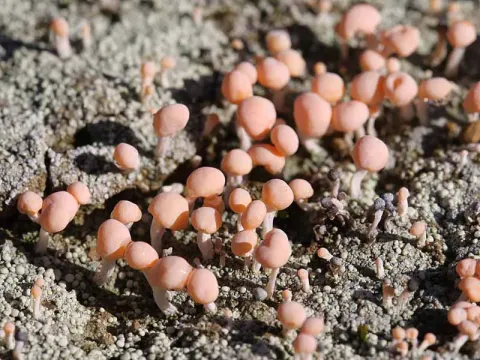
Baeomyces appears as colonies of lichens forming small, often raised thalli on the substrate. They look like granular or crusty patches ranging from greyish to whitish shades.
What the section contains
Baeomyces
They are primarily located on old tree trunks, branches with rough bark, and even soil patches that have remained uncovered by vegetation for a long period.
A characteristic feature is the presence of apothecia—fruiting bodies that in many species of this genus are elevated on short stalks, resembling tiny mushrooms.
Unlike true pathogens, lichens do not have a mycelium that penetrates deep into living plant tissues, but their presence significantly alters the bark's texture.
Visually, the affected surface appears uneven and rough, which is often mistakenly identified as a bark necrosis or a disease by novice gardeners.
It is important to clarify that Baeomyces is not a pathogenic fungus or bacterium causing plant disease, but a genus of lichens (symbiotic organisms).
Biologically, it consists of ascomycete fungal hyphae and algae cells living in close association, obtaining nutrients primarily from the air and precipitation.
The lichen does not feed on the host plant's sap; it uses tree bark solely as a physical substrate for attachment and stability.
This organism is classified as an epiphyte, occupying its ecological niche by using the tree as a base for photosynthesis and reproduction.
Thus, Baeomyces is not a disease-causing agent, although its excessive growth may indicate a general decline in the tree's vitality.
The growth of Baeomyces depends directly on the level of air humidity in the orchard or forest, as lichens require moisture access for their metabolism.
Light exposure is a key factor; most species prefer areas with moderate light where they are sheltered from scorching sun but provided with good ventilation.
Old, decaying bark provides a favorable environment for lichen colonization, offering a porous surface for the attachment of spores.
Lack of proper canopy maintenance, dense planting, and poor aeration create a microclimate conducive to the rapid spread of lichens along branches.
Air quality also plays a role, as most lichen species are highly sensitive to pollution, making their abundance an indicator of regional ecological health.
Although Baeomyces is not a parasite, its presence in large quantities on fruit trees can cause indirect harm to agricultural crops.
The spreading thalli can hinder normal gas exchange in the bark, potentially slowing down vital processes in the stem's epidermal layer.
Moisture trapped under the dense lichen crusts creates an ideal breeding ground for true pests, such as scale insects or mites.
Furthermore, lichen colonies often conceal symptoms of actual diseases, such as bacterial burn or necrosis, complicating early diagnosis.
Aesthetically, a dense layer of lichen on young saplings is often perceived as a sign of poor growth, requiring agricultural intervention.
The most effective method for controlling unwanted lichens is the manual cleaning of tree trunks during the dormant season.
Applying a diluted solution of iron sulfate helps disinfect the bark surface and promotes the decay of the lichen thallus.
Timely pruning of dead or affected branches improves canopy aeration, creating conditions that are less suitable for epiphyte colonization.
Whitewashing trunks with lime-based solutions is a classic and highly effective preventive measure against lichen growth on both young and mature trees.
- Ensuring optimal tree nutrition
- Regular sanitary pruning
- Timely pest management
- Maintaining overall agricultural hygiene