
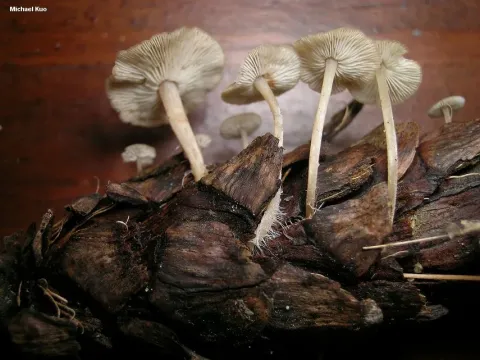
Baeospora myriadophylla
Baeospora myriadophylla
Baeospora myriadophylla is a mushroom species within the Mycenaceae family. It is vital to clarify that it is not a plant disease and poses no risk to agricultural crops or commercial horticulture.
What the section contains
Baeospora myriadophylla
The fungus is classified as a saprotroph. Its biological role is to decompose dead organic matter, specifically decaying wood, contributing to nutrient cycling within forest environments.
Unlike parasitic fungi, this organism does not attack living plant tissues. It lacks the biological mechanisms to penetrate the immune defenses of healthy crops, as it relies on already dead woody substrates.
The taxonomic identity of the species is defined by its crowded, delicate gills underneath the cap. The term "myriadophylla" literally refers to this "myriad of gills" structure.
For agricultural specialists, recognizing this fungus is a matter of forest ecology. It serves as an indicator of organic debris decomposition in woodland edges rather than a target for pest management.
The development of Baeospora myriadophylla is strictly confined to damp, forested environments where coniferous wood decay occurs. It requires a stable microclimate provided by forest cover.
The mycelium thrives by breaking down complex polysaccharides found in dead logs and branches. This process is essential for soil formation and maintaining healthy forest floors.
Environmental conditions such as high humidity and moderate temperatures are critical for the formation of the mushroom's fruiting bodies, typically appearing in the late autumn months.
It cannot survive in standard agricultural fields because it lacks the necessary woody substrate and the specific moisture conditions required for mycelial growth.
Reproduction occurs via spores released from the gills. These spores are distributed by wind currents, seeking out suitable decaying coniferous wood to continue the life cycle.