
Baeomycetaceae lichens
Baeomycetaceae
Description
Symptoms
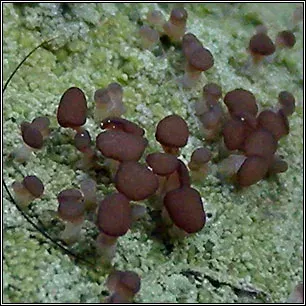
The presence of Baeomycetaceae is identified by small, mushroom-like growths appearing on the trunks and main branches of trees, particularly in older specimens.
The thallus typically exhibits shades of grey, whitish, or greenish-grey, becoming more prominent when hydrated during humid weather conditions.
Apothecia look like small, stalked caps that emerge from the surface, creating a textured or rough appearance on the bark.
Unlike parasitic infections, these lichens do not cause tissue necrosis or rot; the underlying bark usually remains healthy unless affected by other diseases.
Observing these growths is easiest after rainfall, as the lichen swells, changing color and contrast against the dry wood surface.
Pathogen
The Baeomycetaceae family consists of lichens, which are symbiotic associations between fungi and algae. While not pathogens in the strict sense, they are frequently encountered as epiphytes on the bark of woody plants in orchards.
The fungus component, or mycobiont, belongs to the Ascomycota division and provides structural support, while the photobiont provides nutrients via photosynthesis.
Members of the genus Baeomyces are recognized by their distinct morphology, featuring a primary thallus often embedded in the substrate and a secondary thallus with stalked fruiting bodies known as apothecia.
They disperse through the production of spores within these apothecia, which are then carried by wind currents to colonize new bark surfaces.
These organisms are slow-growing and do not actively extract sap from the host tree, functioning rather as opportunistic residents on the surface of the bark.
Conditions for development
Baeomycetaceae thrive in environments with high relative humidity and poor air circulation, which are common in densely planted or unpruned orchards.
Shaded areas within the canopy provide the ideal moisture retention necessary for the establishment and slow growth of these lichen colonies.
Old trees with thick, fissured bark provide excellent anchorage, allowing lichens to accumulate over several years of undisturbed growth.
The absence of industrial air pollutants, such as sulfur dioxide, often allows lichens to proliferate, serving as indicators of relatively clean but poorly managed garden air.
Temperate climates facilitate their growth cycle, enabling them to expand their coverage during long, damp spring and autumn periods.
Why it matters
While not feeding on the host, lichens can serve as a refuge for pests such as mites, scale insects, and their eggs, providing shelter from environmental stressors.
Dense lichen coverage can trap excess moisture against the bark, creating a micro-environment that may encourage the development of opportunistic fungal pathogens.
The accumulation of epiphytic material may hinder bark respiration and gas exchange, which could place additional stress on younger or less vigorous trees.
Their visual dominance often obscures the early symptoms of severe tree diseases like cankers, making timely diagnosis and intervention more difficult.
Heavy lichen growth is often a symptom of neglected orchard hygiene, suggesting that the trees might not be receiving sufficient care or monitoring.
Protection
Regular pruning is the most effective cultural practice, as it opens the canopy to sunlight and improves airflow, making the bark surface less hospitable to lichens.
Mechanical removal, involving the gentle scraping of old bark and lichen colonies with a wire brush, helps keep the trunk surface clean.
Applying a lime wash, often fortified with copper sulfate, to the trunks of trees acts as a chemical deterrent, creating an alkaline environment that inhibits lichen colonization.
Dormant season sprays with ferrous sulfate solutions are highly effective in killing lichen colonies, causing them to dry up and fall off the tree bark.
Maintaining optimal tree vigor through balanced fertilization and proactive pest management reduces the overall suitability of the host for epiphytic growth.
Discussion
No discussions yet — be the first.