
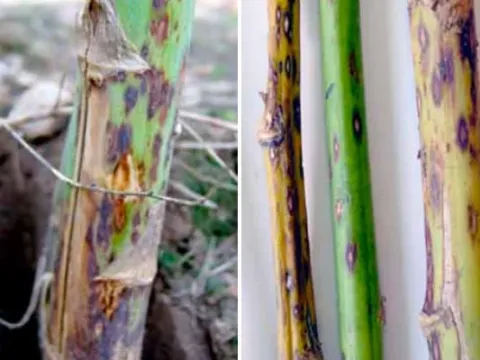
Asparagus decline syndrome
Asparagus
The primary symptom of asparagus decline is the premature yellowing and wilting of the fern canopy during the summer months.
What the section contains
Asparagus decline syndrome
Affected plants often show stunted growth, resulting in thin, spindly spears that lack commercial quality and marketability.
Upon examination of the root system, one can observe brown or reddish-brown necrotic lesions on the rhizomes and feeder roots.
As the disease progresses, the roots become decayed, leading to the death of the entire crown and the appearance of gaps in the field.
The syndrome often manifests in patches where clusters of dying plants appear among healthy ones, reflecting the soil-borne nature of the pathogen.
The syndrome is primarily caused by a complex of fungal pathogens, with Fusarium oxysporum f. sp. asparagi being the most prevalent.
It is classified as a soil-borne vascular wilt disease that colonizes the plant's xylem and disrupts water and nutrient transport.
The fungus produces chlamydospores, which allow it to survive in the soil for many years in the absence of a host plant.
Other species such as Fusarium proliferatum are frequently involved in this disease complex, exacerbating the severity of symptoms.
Infection usually begins through wounds in the roots or at the crown, allowing the fungus to invade the vascular tissue efficiently.
High soil moisture combined with poor drainage is a major environmental driver that promotes root decay and pathogen proliferation.
Warm soil temperatures are highly conducive to the activity of Fusarium, increasing the rate of infection in developing asparagus crowns.
Heavy, poorly aerated soils create stress for the root system, making plants significantly more susceptible to fungal attacks.
Imbalanced fertilization, particularly high nitrogen application, can encourage succulent growth that is more prone to pathogen invasion.
Damage to the roots by mechanical cultivation or soil-dwelling insects provides easy access for the fungus to penetrate the plant tissues.
The main impact is the progressive reduction of plant stand density, leading to a drastic decline in overall field productivity over time.
Weakened plants produce fewer and lower-quality spears, which reduces the farm's annual yield and economic efficiency.
The disease impairs the plant's ability to store necessary carbohydrates in the roots, reducing winter hardiness and plant longevity.
Once established in a field, the disease is extremely difficult to eradicate, often forcing growers to remove the entire plantation.
Asparagus decline causes long-term economic losses due to the high costs associated with land reclamation and replanting.
The most effective strategy is the use of disease-free, certified crowns and maintaining strict sanitation practices in the nursery.
Long-term crop rotation is essential, ensuring that new asparagus fields are planted on ground that has not hosted the crop for several years.
Improving field drainage is critical to prevent waterlogging, which is a major factor in the development of root rot diseases.
Maintaining soil health through appropriate pH management can help create an environment less favorable for the survival of the pathogen.
- Removing and destroying infected plant material promptly;
- Applying biological fungicides such as Trichoderma species;
- Minimizing root stress through careful mechanical handling;
- Monitoring field health to identify and isolate early infection sites.