
Asian soybean rust
Phakopsora pachyrhizi
Description
Symptoms
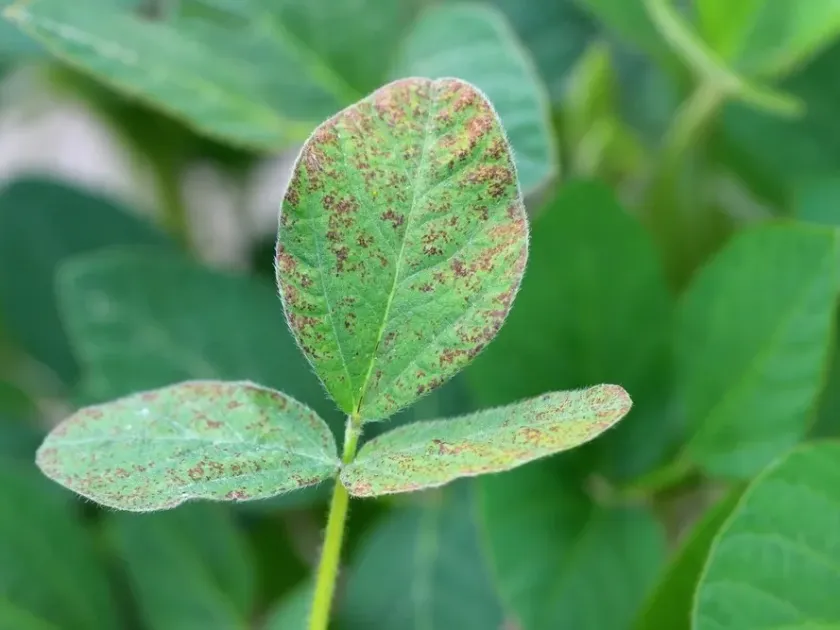
Symptoms typically start as small, yellow flecks on the lower leaves of the soybean plant. Over time, these spots darken and develop into small, raised pustules on the underside of the leaf.
The pustules rupture to release masses of brown or rust-colored spores, which give the disease its name. These spores are easily visible as a fine powder when brushed against or touched.
Advanced stages of the infection cause premature yellowing, leaf necrosis, and heavy defoliation. The loss of leaf surface area drastically inhibits the plant's ability to conduct photosynthesis, weakening the entire structure.
In cases of severe infestation, the disease progresses rapidly from the bottom of the plant to the upper canopy, resulting in widespread chlorosis and reduced plant health.
- Appearance of small, chlorotic spots on leaves.
- Development of brown pustules containing fungal spores.
- Visible spore dust on the leaves.
- Premature dropping of leaves (defoliation).
- Poor pod filling and shriveled, underdeveloped seeds.
Pathogen
Asian soybean rust is a fungal disease caused by the obligate parasite Phakopsora pachyrhizi. This pathogen belongs to the Basidiomycota phylum and is a highly specialized fungus that infects various leguminous species.
The fungus acts by penetrating the leaf tissue through the stomata. As an obligate parasite, it relies entirely on the nutrients derived from the host plant to survive and complete its complex biological life cycle.
The primary mechanism of spread is through urediniospores, which are easily transported by wind currents. These spores can travel hundreds of kilometers, enabling the disease to spread rapidly across vast agricultural landscapes.
The life cycle of the pathogen is marked by rapid sporulation. In optimal conditions, the fungus can produce new generations of spores in just over a week, making it a highly aggressive and difficult disease to contain.
While soybean is the main economic host, the fungus can survive and multiply on a wide range of alternative leguminous hosts, ensuring its persistence in the environment during the off-season.
Conditions for development
Asian soybean rust thrives in moderate temperature ranges, specifically between 20°C and 25°C. These temperatures are ideal for the germination and penetration of fungal spores.
High relative humidity, frequent rainfall, heavy dew, or persistent fog are critical factors that promote the development of the disease by maintaining wetness on the leaf surface.
The disease is most prevalent during the reproductive stages of soybean growth, particularly from flowering through pod filling, when the plant is most resource-intensive.
Thick, dense canopies create a microclimate with high moisture retention, which serves as a breeding ground for the pathogen, significantly accelerating its spread within the field.
The dispersal of the disease is heavily reliant on weather patterns, as wind and water splashes are the main agents that carry the inoculum from one plant to another.
Why it matters
Asian soybean rust is recognized as one of the most destructive diseases in soybean production worldwide. The damage is primarily caused by the reduction in leaf area, which limits grain yield.
Yield losses can be significant, ranging from 10% to over 80%, depending on how early the infection strikes and the effectiveness of the protective measures applied.
In addition to yield quantity, the disease impacts grain quality, often leading to reduced oil and protein content, which diminishes the market value of the harvested crop.
Premature leaf drop often leads to early ripening and poorly filled pods, causing small, shriveled seeds that may not meet commercial quality standards.
The economic impact also includes the high cost of intensive chemical control programs, which are often necessary to maintain profitability in high-risk production regions.
Protection
The primary control strategy involves the timely application of systemic fungicides, including triazoles, strobilurins, and carboxamides. Applications should begin at the first sign of infection.
Field scouting and the use of weather-based disease risk models are essential for early detection, which allows for precise and cost-effective management of the outbreak.
Breeding for resistant soybean varieties is a critical long-term strategy, though the pathogen's ability to evolve requires a continuous approach to managing resistance traits.
Cultural practices, such as crop rotation and the management of volunteer soybean or alternative leguminous weeds, help to reduce the primary inoculum load in the field.
Optimizing plant population and nitrogen management can help improve plant health, making the crop slightly less susceptible and better able to tolerate the pressure of the disease.
Discussion
No discussions yet — be the first.