
Asian soybean rust
Neophysopella
Description
Symptoms
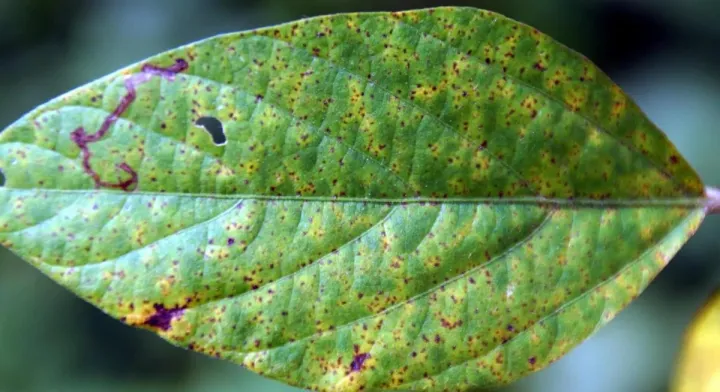
Initial symptoms of Asian soybean rust typically appear on the undersides of the lowest leaves. The first signs are tiny chlorotic spots that eventually turn tan or reddish-brown in color.
The characteristic feature of the disease is the presence of eruptive pustules known as uredinia on the underside of the leaves. These pustules release masses of rusty-colored spores, which are often visible to the naked eye.
As the infection progresses, the lesions expand and coalesce, leading to extensive tissue death. The affected foliage turns yellow, then brown, and eventually drops off the plant prematurely.
Defoliation often starts from the bottom of the plant and moves upwards, resulting in severe stripping of the leaves, which significantly impacts the plant's ability to fill pods effectively.
- Development of small chlorotic lesions on lower leaves.
- Formation of eruptive, rust-colored pustules.
- Premature yellowing and leaf senescence.
- Stunted pod filling and premature ripening.
Pathogen
The causal agent of Asian soybean rust is the obligate biotrophic fungus Phakopsora pachyrhizi. As an obligate parasite, it relies entirely on living host tissue to complete its life cycle and derive nutrients for growth.
The pathogen is a member of the rust fungi group. It specifically targets the foliage of the soybean plant, though under severe conditions, it can affect other green parts, significantly impairing the plant's photosynthetic capacity.
The fungus is primarily dispersed via urediniospores, which are microscopic and easily carried over hundreds of kilometers by wind currents, making it a highly mobile and dangerous agricultural pathogen.
Its life cycle involves the formation of uredinia, which are structures that rupture the leaf epidermis to release massive amounts of spores. This rapid production allows the disease to spread exponentially within a short timeframe.
Since the fungus lacks dormant structures that can survive harsh winters, it relies on the availability of green host plants throughout the year to persist, creating a continuous cycle of infection in warmer climates.
Conditions for development
The development of the disease is strictly dependent on environmental conditions. The optimal temperature range for spore germination and infection is between 15 and 25 degrees Celsius, typical of the main growing season.
Free moisture is the most critical requirement for the infection process. Extended periods of leaf wetness, caused by rain, heavy dew, or prolonged fog, are essential for the spores to germinate and penetrate the host tissue.
Relative humidity levels consistently above 80 percent create an ideal environment for the fungus. In such humid conditions, the incubation period can be as short as 5 to 8 days, leading to rapid outbreaks.
Dense crop canopies often create a microclimate that traps moisture and maintains lower temperatures in the lower leaf layers, making these areas the primary sites for initial disease colonization.
Frequent rain events followed by periods of wind facilitate both the infection process and the secondary dispersal of spores to neighboring plants, causing rapid field-wide epidemics.
Why it matters
The primary damage caused by Asian soybean rust is the severe reduction of the photosynthetic surface area. By inducing premature defoliation, the disease prevents the plant from producing enough carbohydrates to support seed development.
This leads to smaller seed sizes, lower oil content, and reduced overall yield. In severe cases, the plant may fail to produce viable seeds altogether, leading to significant economic losses.
Yield losses can range from 30 to 80 percent, depending on the stage of the plant when the infection occurs. Early-season infections are particularly devastating to the final crop potential.
Additionally, the weakened plants are more susceptible to secondary pathogens and environmental stresses, further compromising the harvest quality and reducing the viability of seeds for future planting.
The economic impact extends to increased management costs, as farmers must invest in repeated fungicide applications to save their crops from total devastation during favorable disease years.
Protection
Fungicides are the cornerstone of managing Asian soybean rust. Preventive applications of systemic fungicides, particularly those containing triazoles, strobilurins, or SDHIs, are highly effective in suppressing the disease.
Integrated Pest Management (IPM) practices, including the use of early-maturing varieties, can help plants escape the peak infection period, thereby reducing the need for intensive chemical intervention.
Regular scouting and field monitoring are essential for early detection. The goal is to identify the first signs of the disease on the lower leaves to ensure that fungicide treatments are applied at the most effective time.
Reducing the presence of alternative host plants and volunteer soybeans in the surrounding area can help lower the initial inoculum pressure at the start of the season.
Maintaining proper plant spacing and row configurations can improve air circulation within the canopy, helping to reduce the humidity levels that the fungus requires to thrive and spread.
Discussion
No discussions yet — be the first.