

Description
Symptoms
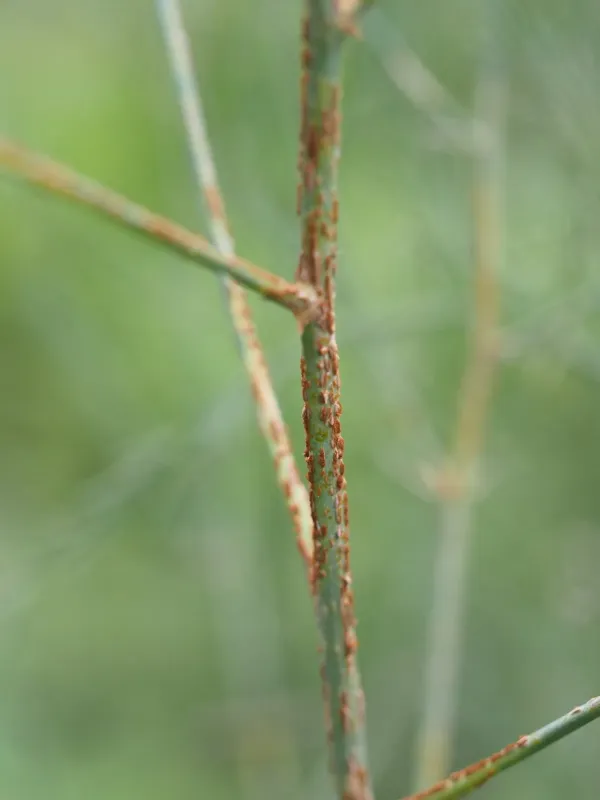
The first signs of the disease appear as small, pale-green spots on the stems, which gradually develop into light-brown pustules. These pustules are the primary visual marker of the fungus's sporulation.
By mid-summer, rust-colored, dusty lesions filled with urediniospores become visible on the asparagus ferns. These spores easily rub off when touched, resembling the appearance of metallic rust.
Toward the end of the season, the color of the pustules changes to black or dark brown, indicating that the fungus has transitioned to the teliospore stage for winter survival. Affected stems yellow and die prematurely.
Widespread infection leads to early defoliation of the cladodes, which completely halts the photosynthesis process. The plant loses its ability to store essential carbohydrates in its rhizomes for the following year.
A visual inspection of the field in August and September allows for easy identification of the disease due to the mass browning of the asparagus canopy. Without proper management, the infection patches spread rapidly across the field.
Pathogen
The causative agent of the disease is a highly specialized fungal pathogen, Puccinia asparagi, which belongs to the class of Basidiomycetes. It is an obligate parasite that undergoes a complex life cycle, alternating between aeciospore, urediniospore, and teliospore stages.
The infection affects exclusively members of the Asparagus genus, particularly Asparagus officinalis. The fungus derives nutrients from the living tissues of the host, depleting the plant's root system throughout the growing season.
The pathogen overwinters as teliospores on plant debris left in the field after harvest. In the spring, these spores germinate to form basidiospores, which are spread by wind to young shoots when moisture is present.
The fungus's life cycle is characterized by high reproductive intensity during the summer, when urediniospores are formed. These spores can cause multiple cycles of re-infection on healthy plants within a single season.
To maintain viability in the soil or on crop residues, the fungus requires moderate humidity and the presence of organic substrate. The severity of the inoculum pressure depends directly on the agricultural practices employed in previous years.
Conditions for development
The development of Puccinia asparagi is favored by frequent fog and heavy dew during nighttime hours. High air humidity combined with temperatures between 15 and 25 degrees Celsius provides an ideal environment for spore germination.
The pathogen is spread primarily by wind currents. Spores can be carried over long distances, making the disease a significant threat to all neighboring asparagus fields in the region.
Overcrowded plantings create a microclimate with poor ventilation. Under these conditions, fungal spores anchor more effectively onto the stem surface and penetrate the plant's stomata to establish mycelial growth.
The presence of free moisture on the stems is a critical factor. Even brief periods of leaf wetness, when paired with warm temperatures, trigger the infection process, which can persist until late autumn.
Poor agricultural practices, such as inadequate soil drainage, also promote the development of rust. Waterlogging increases the overall humidity level, which facilitates the multiplication of pathogenic microorganisms.
Why it matters
The primary damage caused by the disease is a drastic reduction in plantation productivity for the following year. Premature senescence of the canopy prevents the rhizome from building up necessary sugar reserves, weakening the plant.
Heavily infected plants become less winter-hardy. Consequently, severe winters often result in the death of asparagus crowns that failed to develop sufficient root mass due to the stress of the infection.
Yield losses can reach 40-60% in the absence of control measures during years favorable for epidemic development. The quality of the marketable spears harvested in the subsequent season is significantly diminished.
The disease leads to the premature exhaustion of the plantation, significantly shortening its functional lifespan. Farmers are often forced to remove the crop and re-establish the field earlier than anticipated.
Infected asparagus loses its marketability and appeal to consumers, resulting in direct economic losses. Damaged stems become brittle and are unsuitable for long-term storage or processing.
Protection
The most crucial preventive method is the thorough removal and destruction of crop residues in autumn. This eliminates the primary inoculum source and reduces the population of teliospores in the field.
Crop rotation and avoiding planting asparagus in low-lying, poorly aerated areas are highly recommended. Choosing well-ventilated sites significantly reduces the risk of mass infestation.
Applying copper-based fungicides or specific systemic products upon the first signs of disease helps suppress fungal spread. Treatments must be carried out strictly according to the product label and regulatory guidelines.
The use of rust-resistant varieties and hybrids plays a vital role. Genetic resistance simplifies crop protection and significantly reduces the dependency on frequent chemical applications.
Timely weed control and maintaining optimal plant spacing improve air circulation. This prevents moisture accumulation on the stems, making the environment less conducive to fungal colonization.
Content graph
Connections · Asparagus rust
Most often together:
Marketplace
Products · 4


Community
Discussion
No discussions yet — be the first.