
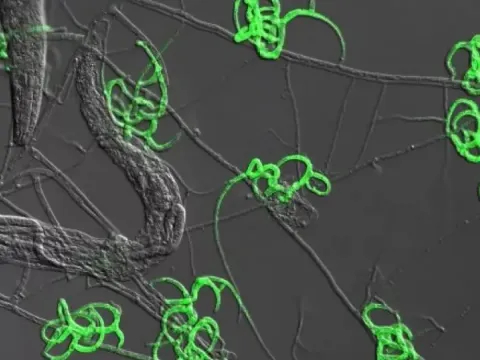
Arthrobotrys oligospora
Arthrobotrys oligospora
Arthrobotrys oligospora is a fascinating soil-dwelling fungus classified as a nematophagous fungus. It is widely recognized in agronomy for its predatory behavior rather than acting as a plant pathogen.
What the section contains
Arthrobotrys oligospora
The fungus is famous for its unique mechanism of trapping: it produces complex adhesive networks or loops that act as snares for microscopic roundworms known as nematodes.
Once a nematode touches the adhesive surface of the trap, it becomes firmly stuck. The fungus then produces penetration hyphae that enter the worm's body and digest its internal tissues to obtain essential nutrients.
Because it targets nematodes, many of which are severe pests of agricultural crops, Arthrobotrys oligospora is considered an essential component of integrated pest management (IPM) strategies.
It exists naturally in the soil, effectively regulating the populations of soil organisms and protecting the root systems of plants from parasitic nematode damage.
Arthrobotrys oligospora thrives in soils with moderate to high moisture levels. Water is crucial for the metabolic processes that lead to the formation of its specialized trapping structures.
The fungus shows peak activity at temperatures ranging from 15°C to 25°C. Outside these ranges, its ability to trap nematodes may decrease significantly as it enters a less active growth phase.
Organic matter content is a key driver for the growth of this fungus. High levels of soil organic carbon support a robust fungal biomass, providing a habitat where the fungus can flourish.
Soil aeration plays a vital role. Proper oxygen availability is necessary for the development of its mycelial network, especially when it is actively searching for and capturing prey.
The presence of nematodes themselves acts as a signal for the fungus, stimulating the production of traps. In nutrient-poor soils, the predation of nematodes provides the fungus with the nitrogen necessary for survival.
It is critical to note that Arthrobotrys oligospora is not a plant pathogen. It causes no diseases, lesions, or growth inhibition in plants, crops, or vegetation.
In a farming environment, it is categorized as a beneficial organism. Its activity is strictly limited to the predation of nematodes and other small soil microorganisms.
There are no negative impacts on crops; instead, the presence of this fungus is often associated with higher soil biological quality and reduced pressure from root-knot and cyst-forming nematodes.
The only risk related to this fungus is its sensitivity to certain synthetic agrochemicals, which can inadvertently eliminate the beneficial population and cause an ecological imbalance.
Consequently, farmers do not need to take any protective measures against this fungus; rather, they should focus on practices that sustain its population within the soil profile.
The management of Arthrobotrys oligospora focuses on conservation and stimulation of its population. The primary goal is to maintain a high-quality soil environment that favors natural predators.
Frequent application of organic materials like compost or mature manure serves as a continuous food source and habitat for the fungus, ensuring its survival even when nematode populations are low.
Avoiding the overuse of broad-spectrum chemical fungicides is essential, as these substances can decimate the populations of beneficial nematophagous fungi, making the soil more susceptible to pest outbreaks.
Crop rotation practices that include biomass-building plants help sustain the microbial activity required by the fungus to maintain its predatory capacity across different growing seasons.
In advanced greenhouse or high-value outdoor farming, biological preparations containing Arthrobotrys oligospora spores can be introduced to the soil as a proactive measure against nematode infestations.