
Arthonia atra
Arthonia atra
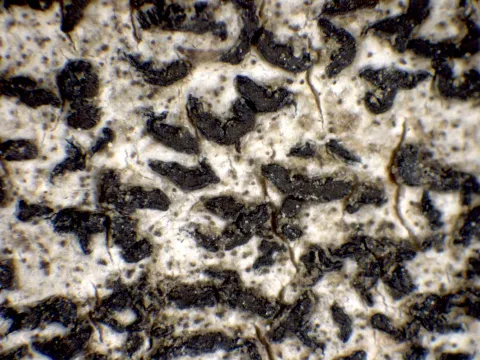
Arthonia atra is an epiphytic lichen that typically colonizes the smooth bark of deciduous trees. It appears as small, dark, almost black spots or fine, squiggly lines that resemble ancient script or drawings.
What the section contains
Arthonia atra
The fruiting bodies of this lichen, known as apothecia, are elongated and irregular in shape. They press tightly against the substrate, often giving the bark a charred or "dirty" appearance.
The infestation usually occurs on branches and trunks where moisture tends to persist. Unlike parasitic fungi, it does not form thick or bushy thalli, making it subtle and easy to overlook.
As the colony expands, these spots may merge into larger darkened patches. Visually, it can be mistaken for chemical staining or the early stages of bark necrosis, though it lacks the characteristic decay of fungal diseases.
A closer inspection with a magnifying glass reveals the characteristic structure of Arthoniaceae, which helps distinguish it from plant-pathogenic infections or physiological bark disorders.
The organism is Arthonia atra, a symbiotic lichen formed by the association of a fungus and an alga. It functions as a standalone unit, using the tree bark strictly as a physical anchor.
It is not a pathogen; it does not infect plant tissues or extract nutrients from the tree. As an epiphyte, it lives independently of the tree’s physiological health.
The biological cycle relies on the alga’s photosynthesis and the fungus’s ability to absorb nutrients from atmospheric dust and rainfall. It does not cause structural damage to the xylem or phloem.
Reproduction occurs via spores discharged from the apothecia, which are dispersed by wind or water. These spores require stable, smooth surfaces to colonize, which is why it favors specific tree species.
This lichen is known to be sensitive to air pollution, particularly sulfur dioxide. Its presence often indicates a relatively clean air environment in the garden or orchard area.
Arthonia atra thrives in shaded, humid environments where moisture remains on the bark surface for extended periods. High relative humidity is the primary driver for colonization.
Trees that exhibit slow bark growth are particularly susceptible, as the lichen can inhabit the same spot for many years without the bark being shed or replaced too quickly.
Dense canopies that restrict airflow and reduce sunlight penetration create the perfect microclimate for this lichen to establish and spread across branches and trunks.
It displays high tolerance to temperature fluctuations common in temperate climates, surviving both summer heat and winter cold quite effectively.
The bark chemistry of specific deciduous trees provides the ideal pH and texture for the lichen to attach its spores, leading to frequent occurrence on species with neutral to slightly acidic bark.
Arthonia atra causes no direct harm to the tree. It is not a parasite, so it does not feed on tree sap, destroy the inner wood, or inhibit the tree’s growth and metabolic processes.
While the lichen itself is harmless, a heavy infestation might indicate that the tree is in poor condition due to other environmental or horticultural factors, such as lack of vigor.
Persistent moisture held by dense lichen cover may create a microenvironment that theoretically supports the development of harmful pathogens, though the lichen is rarely the primary cause of such issues.
In ornamental settings, the presence of these black markings may be considered aesthetically undesirable, as gardeners often perceive them as a sign of poor garden maintenance.
In professional orchards, distinguishing between this harmless lichen and true bark diseases is essential to avoid unnecessary chemical applications and to focus resources on real health issues.
The most effective preventive measure is proper canopy management. Regular pruning ensures sufficient light and air circulation, keeping the bark dry and less hospitable to lichen growth.
If removal is desired for aesthetic reasons, mechanical cleaning with soft scrapers or wire brushes can be performed, ensuring the underlying bark layer is not damaged during the process.
Applying a lime wash or a specialized bark treatment after cleaning can disinfect the surface and create a high-pH environment that is unfavorable for the re-establishment of lichen spores.
Maintaining high horticultural standards, including adequate irrigation and fertilization, encourages vigorous bark growth and natural shedding, which effectively prevents long-term lichen colonization.
While fungicide applications (e.g., copper-based products) for other diseases may reduce the lichen population, they are not necessary or recommended solely for the control of Arthonia atra.