
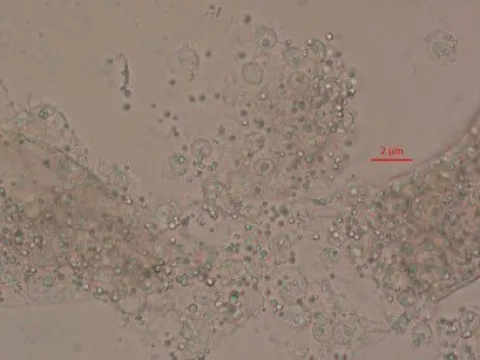
Pasteuria penetrans
Pasteuria penetrans
Pasteuria penetrans is a specialized, obligate bacterial parasite that targets various species of root-knot nematodes (Meloidogyne spp.). Unlike typical crop pathogens, this bacterium acts as a natural biological control agent in the soil ecosystem.
What the section contains
Pasteuria penetrans
The life cycle begins when bacterial spores attach to the cuticle of second-stage juvenile (J2) nematodes. These juveniles are the mobile, infective stage of the parasite that actively seeks out plant roots for colonization.
Once attached, the spore germinates by forming a germ tube that enzymatically penetrates the nematode's cuticle. This physical intrusion allows the bacterium to enter the internal body cavity (pseudocoelom) of the host.
Inside the host, the bacteria undergo vegetative growth, effectively utilizing the nematode's nutrients. This process causes the nematode to become sterile and eventually kills it, as the internal structures are replaced by bacterial colonies.
Finally, the nematode body becomes a mass of new spores. These are released into the soil after the host carcass decomposes, creating a reservoir of inoculum that can infect subsequent generations of nematodes.
The success of Pasteuria penetrans is highly dependent on the density of the nematode host population. A minimum threshold of nematode presence is required to sustain the bacterial population in the soil.
Soil temperature is a critical environmental factor for spore germination and infection. Research indicates that soil temperatures between 20°C and 30°C are most conducive to the rapid spread of the bacteria.
Soil moisture levels significantly influence the movement of juvenile nematodes and the dispersal of bacterial spores. Moderate moisture is necessary for the initial contact between the spore and the host cuticle.
Soil texture affects the bacterial efficacy; lighter, sandy soils often show higher rates of infection due to the increased mobility of nematodes and the easier distribution of microscopic spores throughout the soil profile.
Chemical conditions such as pH and the presence of antagonistic microorganisms can also modulate the effectiveness of the pathogen. Maintaining a balanced soil microbiome is essential for long-term biocontrol success.
While termed a pathogen in biological terms, Pasteuria penetrans is extremely beneficial for agricultural production. It causes severe reproductive failure in harmful root-knot nematodes.
Infected nematodes fail to develop into mature females and are unable to produce egg masses. This prevents the formation of root galls, which are the hallmark of nematode damage in susceptible crops like tomatoes, cucumbers, and legumes.
By suppressing the nematode population, the bacterium allows the plant's root system to remain healthy, leading to better nutrient uptake, improved plant vigor, and higher crop yields.
The use of this bacterium is considered a cornerstone of sustainable agriculture, as it provides a targeted, environmentally friendly alternative to harsh synthetic nematicides.
Because the bacterium is highly specific to certain nematode groups, it leaves beneficial soil organisms, such as earthworms and non-target insects, completely unharmed.
Successful management involves applying spore-rich formulations to the soil prior to planting. Uniform distribution is necessary to ensure the spores reach the root zone where nematodes congregate.
To maximize the biocontrol impact, growers should integrate cultural practices that support soil health. Minimizing the use of broad-spectrum pesticides is crucial to protect the bacterial inoculum.
Crop rotation and the use of cover crops can help manage nematode pressure, creating a stable environment where Pasteuria penetrans can maintain its suppressive effect on nematode populations.
Because the bacterium cannot be grown on standard artificial laboratory media, mass production remains a challenge. This often leads to the implementation of small-scale on-farm multiplication strategies in some regions.
Monitoring the effectiveness of this biocontrol agent involves evaluating the root gall index and checking nematode cadavers under a microscope for the presence of typical bacterial spore encrustations.