
Pasteuria
Pasteuria
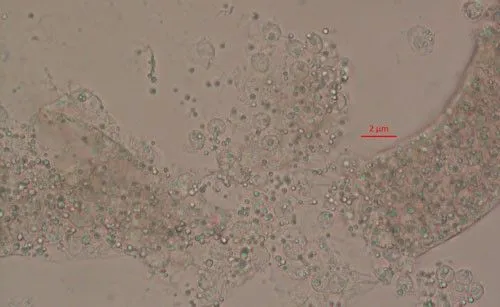
Description
Symptoms
Visually detecting a Pasteuria infection in field conditions is impossible without laboratory analysis due to the microscopic size of the organisms.
Evidence of the bacteria's presence in the soil is primarily shown by a decrease in the severity of root-knot nematode damage and a slowdown in the pest population growth rate.
Microscopic examination of nematodes extracted from the soil reveals Pasteuria spores attached to their surface, appearing as small, rounded projections.
The internal organs of an infected nematode undergo gradual degradation, which can be observed as a change in the clarity of the nematode's body under a microscope.
During mass mortality events of nematodes, an overall improvement in the health of the plant root system is typically observed, especially in fields previously suffering from nematode-induced galls.
Pathogen
Pasteuria is a genus of soil-dwelling obligate bacteria that act as natural parasites of plant-parasitic nematodes. Unlike fungal pathogens, these microorganisms have a highly specialized life cycle directly tied to their host.
The most significant species is Pasteuria penetrans. These bacteria produce highly resilient endospores capable of surviving in the soil for many years while waiting for contact with a suitable host nematode.
The infection process begins when spores attach to the cuticle of a nematode as it moves through the soil solution. Once attached, the spore germinates, and the bacterium's mycelium penetrates the host's body.
The bacterium colonizes the nematode's body cavity, consuming its nutrients for its own reproduction. Consequently, the infected nematode loses its ability to feed, move, or reproduce.
Ultimately, the host dies, and its body becomes a vessel filled with thousands of new Pasteuria spores, which are released into the soil upon the disintegration of the host's cuticle.
Conditions for development
The development of Pasteuria is directly dependent on the presence of host nematode populations, as the bacteria cannot proliferate in the soil without feeding on host tissues.
Optimal conditions for spore spread include moderate soil moisture and temperatures between 20–30 degrees Celsius, which coincide with the peak activity of most root-parasitic nematodes.
Active spore distribution is facilitated by soil cultivation practices, irrigation, and the movement of soil particles via runoff or irrigation water.
The bacterium is sensitive to high levels of soil chemical contamination, so the use of harsh chemical fumigants can suppress its natural activity.
High nematode population density in the plant rhizosphere accelerates the «epidemic» among parasites by increasing the probability of spore-host contact.
Why it matters
It is important to note that in an agronomic context, Pasteuria is not a disease of the crops themselves, but rather a beneficial agent of biological control.
It poses a threat exclusively to harmful nematodes that attack a wide range of crops, including vegetables, fruits, and industrial plants.
A lack of sufficient Pasteuria in the soil, combined with a high nematode presence, leads to uncontrolled pest proliferation and crop yield losses of 50% or more.
The only potential drawback lies in the high host specificity of certain Pasteuria strains, which may only infect specific types of nematodes.
Therefore, incorrect strain selection or failure to provide suitable environmental conditions can render biological protection ineffective in specific field settings.
Protection
The primary method of using Pasteuria involves creating conditions for the accumulation of its natural soil population or introducing commercial bio-preparations.
To preserve endospores in the soil, it is recommended to minimize the use of chemical nematicides that may negatively impact the population of beneficial microflora.
Effective practices include cultivating antagonist plants and using crop rotations that foster the reproduction of entomopathogenic microorganisms.
- Applying organic fertilizers to enhance overall soil microbiological activity.
- Maintaining proper irrigation regimes to prevent the desiccation of the topsoil layer.
- Using high-quality planting material certified as nematode-free.
Currently, research is ongoing regarding the mass production of Pasteuria to develop targeted bio-insecticides against specific species of nematodes.
Discussion
No discussions yet — be the first.