
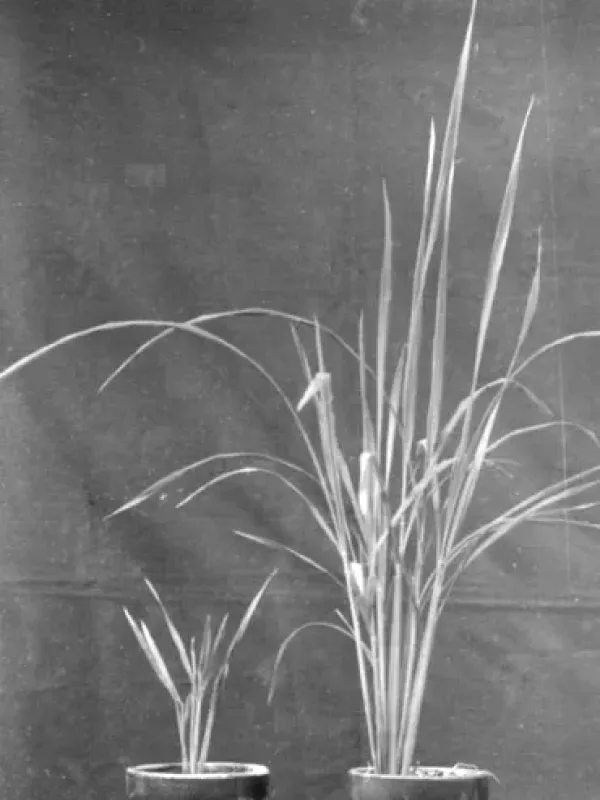
Description
Symptoms
The primary symptom of Rice gall dwarf disease is the development of distinct galls on the lower surface of leaf blades and leaf sheaths.
Infected rice plants exhibit severe stunting, appearing significantly shorter than healthy plants within the same field.
Leaves often become deep green, stiff, and may show a twisted or spiral growth pattern due to the abnormal development of plant tissues.
Affected plants show increased tillering; however, the newly formed tillers remain underdeveloped and stunted, giving the plant a bushy appearance.
Panicle exertion is frequently inhibited, or if they emerge, they remain sterile and fail to produce viable rice grains.
Pathogen
The disease is caused by the Rice gall dwarf virus (RGDV), which is a member of the Phytoreovirus genus within the Reoviridae family.
The virus consists of a spherical particle with a double-layered capsid containing a segmented double-stranded RNA genome.
It is an obligate virus that requires biological vectors, specifically leafhoppers, to move from one host plant to another.
Major insect vectors for RGDV include the green leafhoppers Nephotettix nigropictus, Nephotettix cincticeps, and Recilia dorsalis.
The virus has a persistent-propagative relationship with its vector, meaning the insect remains infective for its entire lifespan after acquiring the virus.
Conditions for development
The spread of the disease is highly dependent on the population density of leafhopper vectors during the critical growth stages of rice.
Warm temperatures and high humidity levels create an ideal environment for the rapid reproduction and migration of the insect vectors.
Various wild grass species act as alternative reservoirs, allowing the virus to persist in the ecosystem during the fallow periods between rice seasons.
Intensive farming practices, such as continuous cropping and improper irrigation management, can significantly increase the prevalence of the virus.
The migration patterns of leafhoppers, often driven by prevailing winds and local climatic conditions, facilitate the spread of the virus between neighboring fields.
Why it matters
Rice gall dwarf causes substantial yield losses, severely impacting the productivity and profitability of rice cultivation.
Infections occurring at the early stages of plant development can lead to complete failure of the crop or total lack of grain formation.
The quality of the harvested rice is often poor, characterized by smaller, lighter grains and higher levels of breakage during processing.
The viral infection disrupts the physiological processes of the plant, lowering its resistance to other biotic and abiotic stresses.
Widespread outbreaks can devastate regional agriculture, requiring significant intervention and leading to decreased food security.
Protection
The most effective strategy for managing Rice gall dwarf is the cultivation of resistant or tolerant rice varieties.
Regular monitoring of leafhopper populations is crucial for determining the timing and necessity of chemical control interventions.
The use of systemic insecticides targeting leafhopper vectors is effective in preventing the primary infection and subsequent secondary spread.
Sanitation practices, including the removal of weeds and infected plant debris, help reduce the local inoculum pressure.
- Implementation of synchronized planting dates to reduce vector access.
- Quarantine measures for plant materials moving between regions.
- Rotation with non-host crops to break the disease cycle.
- Integrated Pest Management (IPM) focusing on biological control of vectors.
- Prompt eradication of symptomatic plants to minimize viral spread.
Pathogens and affected parts
Affects crops · 1
Discussion
No discussions yet — be the first.