
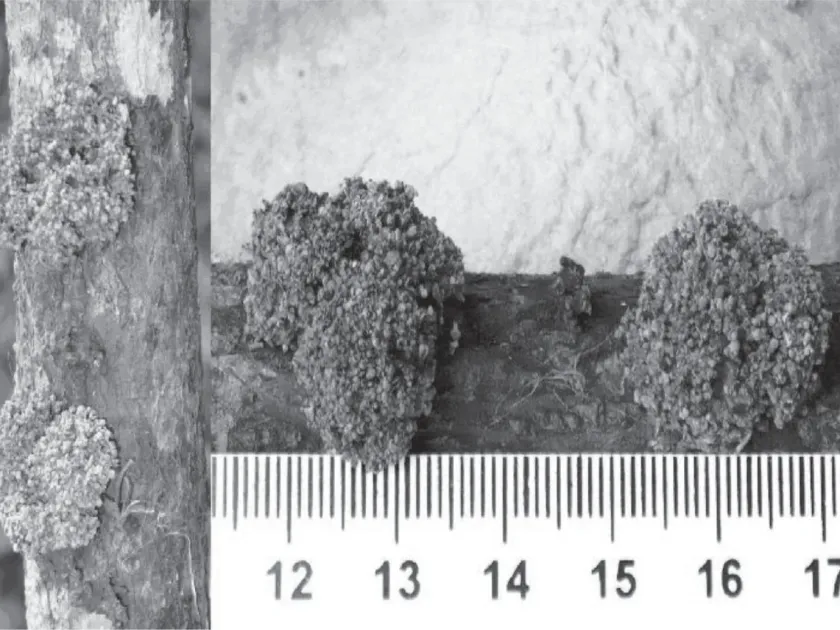
Description
Symptoms
The hallmark of this disease is the development of galls—abnormal outgrowths on branches. These are caused by the disruption of plant growth regulators, leading to uncontrolled cellular proliferation.
Initially, small swellings appear on the bark. Over time, these develop into large, rugged, and woody tumors that severely distort the affected branch structure.
Leaves on infected branches often undergo chlorosis and premature abscission. In severe cases, the entire canopy architecture is affected, leading to a significant loss of photosynthetic capacity.
The interior of the galls is often spongy and can become a site for secondary infections, including soft-rot bacteria, which release a foul odor as the tissue decomposes.
On mango trees, the infection can manifest as localized bark necrosis or distorted twig growth, often referred to as "witches' broom" symptoms in some severe manifestations.
Pathogen
The causal agent of cacao gall disease is the fungus Calonectria rigidiuscula (teleomorph Fusarium decemcellulare). This pathogen is a filamentous fungus known for infecting the bark and woody tissues of tropical plants.
The fungus invades the host plant through mechanical injuries or wounds caused by boring insects. Once established, it releases spores that are disseminated primarily by rainwater splashes and wind currents.
The pathogen has a wide host range. In addition to cacao (Theobroma cacao), it frequently affects mango (Mangifera indica), causing significant lesions and structural malformations on stems and branches.
It acts as a facultative parasite, capable of surviving on debris in the soil or decaying branches, which makes field sanitation extremely challenging for plantation management.
The pathogen's biology is highly dependent on tropical environmental conditions, where constant high humidity and warm temperatures trigger rapid sporulation and tissue colonization.
Conditions for development
High humidity is the primary driver for disease development. Excessive rainfall and constant mist create an environment that favors the survival and germination of fungal spores.
The presence of insect pests, particularly those that feed on or bore into the bark, is a critical factor. These insects provide the entry points necessary for the fungus to bypass the plant's natural defenses.
High-density planting leads to poor airflow and creates a stagnant microclimate within the canopy, which allows the pathogen to spread more easily between trees.
Plants suffering from nutrient deficiencies or other environmental stressors are significantly more susceptible to infection compared to well-nourished, vigorous trees.
The optimal temperature for fungal growth inside the host tissue ranges from 24°C to 30°C, which explains the high prevalence of the disease throughout the year in tropical regions.
Why it matters
Cacao gall disease significantly impairs the vascular system of the tree, blocking the translocation of water and essential nutrients to the fruits and growing tips.
The resulting physiological stress reduces the plant's overall energy levels, leading to a marked decrease in yield and lower quality of the harvested cocoa beans.
Severe infestations can lead to the death of the tree after a few years of chronic infection. This forces farmers to remove and replace expensive crop stands, causing economic loss.
Infected trees act as continuous reservoirs for the pathogen. Without intervention, the disease spreads rapidly across the plantation, creating an epiphytotic scenario.
For mango crops, the disease reduces the tree's lifespan and fruit quality, decreasing the long-term profitability of the orchard.
Protection
Sanitation through pruning is the most critical control measure. Infected branches must be removed, cutting well into healthy tissue, and destroyed by burning away from the field.
Integrated Pest Management (IPM) is essential to control insect vectors. Using targeted insecticides helps prevent the mechanical wounds that allow the fungus to infect the tree.
The use of resistant cultivars is the most effective long-term strategy. Breeding programs focusing on disease resistance are crucial for the sustainability of cocoa farming.
Maintaining proper tree spacing and regular canopy thinning ensures better aeration, which dries out the bark and reduces the likelihood of fungal spore germination.
- Apply fungicides or disinfectant pastes to pruning wounds.
- Implement regular scouting programs to detect early signs of gall formation.
- Improve overall soil health to boost plant vigor and innate immunity.
Pathogens and affected parts
Affects crops · 1
Discussion
No discussions yet — be the first.