
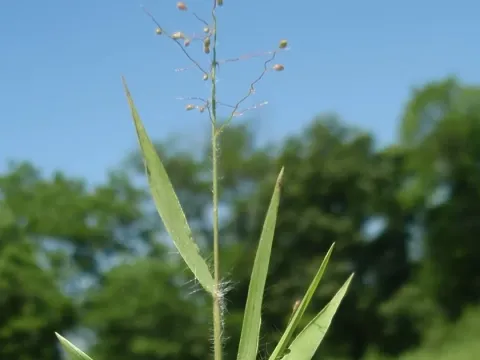
Woolly panicgrass
Panicum lanuginosum
Woolly panicgrass (Panicum lanuginosum) is a perennial grass species belonging to the Poaceae family. While often found in the wild, its agronomic management focuses on fostering its growth within managed rangelands and natural pastures.
What the section contains
Woolly panicgrass
The optimal seeding period occurs in mid-to-late spring. Sowing should commence once the soil temperature is consistently above 10 degrees Celsius, ensuring that the seeds have sufficient warmth to trigger the germination process successfully.
Seedbed preparation is essential for successful establishment. Given the small size of the seeds, the soil must be finely tilled and leveled to prevent deep burial, which can inhibit the emergence of delicate seedlings during the first few weeks.
Recommended seeding depth is approximately 1 to 2 centimeters. Using a seed drill or broadcast seeding followed by light harrowing helps ensure an even distribution, which promotes uniform growth and higher density of the resulting turf.
Post-seeding compaction using a roller is a highly recommended agricultural practice. This process improves seed-to-soil contact and facilitates the upward movement of capillary water, which is critical for supporting the initial stages of seedling development.
This species is well-adapted to various soil types, ranging from sandy to loamy textures. It performs best in well-drained conditions, as it is sensitive to waterlogged environments which can lead to root system degradation.
As a heliophyte, woolly panicgrass requires ample sunlight to maximize its photosynthetic capacity. Open areas allow for superior biomass production, whereas significant shade will typically lead to reduced vitality and sparser plant density.
The grass is known for its remarkable drought tolerance. Its root architecture is designed to capture moisture efficiently, allowing it to survive periods of limited rainfall that would otherwise stress more sensitive agricultural grasses.
Regarding soil fertility, it thrives in moderate conditions but responds positively to basic fertilization. Phosphorus and potassium are the primary nutrients that contribute to stem stability and long-term perennial health of the plant stands.
Soil pH should ideally range between 5.5 and 7.0 for optimal nutrient availability. Although it exhibits resilience to varying acidity levels, extreme alkalinity or high salinity should be avoided to prevent stunting of the vegetative growth.
The primary diseases affecting woolly panicgrass include various rust fungi. These pathogens create small pustules on the leaf surfaces, which disrupt the plant's metabolic functions and reduce the overall nutritional quality of the forage.
Root rot, often associated with soil-borne fungi, can pose a risk in areas with poor drainage. Proactive management involves ensuring proper field drainage and avoiding excessive irrigation that leads to oxygen depletion in the soil profile.
Pest pressures are generally manageable, with aphids being the most common threat. These insects colonize the younger leaves and stems, extracting sap and potentially acting as vectors for viral diseases that further stress the plant population.
Grasshoppers and other lepidopteran larvae may occasionally cause defoliation. Regular scouting of the pasture is necessary to detect such infestations early and to determine if intervention is needed to protect the forage supply.
Maintaining high plant vigor through proper rotational grazing is the most effective biological defense. Healthy plants are better equipped to withstand environmental stress and exhibit higher resistance to both fungal and insect damage.
Harvesting woolly panicgrass for hay requires precise timing to capture the peak nutritional value. Cutting should occur just before the flowering stage, as this is when the plant contains the highest concentration of crude protein and digestible fiber.
The height of the cut is crucial for the plant's regrowth. Leaving a residual stubble height of at least 5 to 7 centimeters ensures that the plant retains enough photosynthetic tissue to recover quickly after the harvest event.
For silage or haylage production, the moisture content must be carefully monitored. The cut biomass should be allowed to wilt properly in the field to reach an optimal dry matter content before baling or storing to prevent spoilage.
Weather conditions play a decisive role in the harvest quality. Ideally, a three-day window of dry, sunny weather is needed to dry the grass effectively, preserving its green color and aroma, which are indicators of high feed quality.
Post-harvest management involves a short period of rest for the field. Allowing the grass to recover without immediate grazing or additional mechanical stress ensures that the root reserves remain sufficient for winter survival and spring growth.