
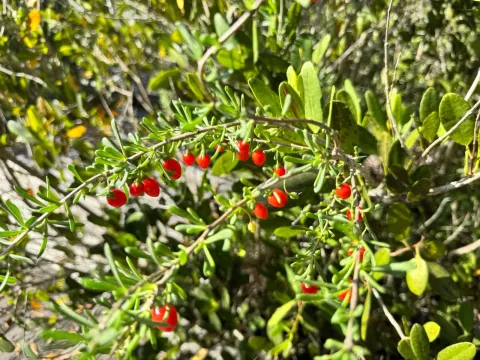
Lycium
Lycium
The propagation of Lycium (Lycium barbarum) is predominantly achieved through vegetative methods, such as cuttings or layering, which ensures the consistency of varietal traits. Transplanting the established saplings into the open field should be performed in early spring or autumn to ensure successful root establishment.
What the section contains
 African boxthorn
Lycium ferocissimum Miers
African boxthorn
Lycium ferocissimum Miers
 Chinese wolfberry
Lycium chinense Mill.
Chinese wolfberry
Lycium chinense Mill.
 Goji berry
Lycium barbarum L.
Lycium cylindricum
Lycium cylindricum Kuang & A. M. Lu
Goji berry
Lycium barbarum L.
Lycium cylindricum
Lycium cylindricum Kuang & A. M. Lu
 Lycium dasystemum
 Pojark.
Lycium dasystemum
Lycium dasystemum Pojark.
 Lycium truncatum
 Y. C. Wang
Lycium truncatum
Lycium truncatum Y. C. Wang
 Lycium yunnanense
 Kuang & A. M. Lu
Lycium yunnanense
Lycium yunnanense Kuang & A. M. Lu
 Russian boxthorn
Lycium ruthenicum Murray
Russian boxthorn
Lycium ruthenicum Murray
Lycium
Seed propagation requires preparing a light, nutrient-rich substrate and maintaining adequate moisture levels. Seeds often benefit from a stratification period in a cool environment before sowing to enhance germination rates and ensure uniformity.
Site selection is critical as Lycium is a light-demanding crop. Choosing an open, sunny location significantly promotes vigorous growth and ensures optimal fruit quality, as shade-grown plants often exhibit reduced productivity.
The spacing between plants must account for the shrub's aggressive growth habit. A distance of approximately 2 meters between bushes allows for efficient maintenance, proper airflow within the canopy, and easier harvesting operations.
Initial irrigation is necessary immediately after planting to support the young root system. Once established, the plants demonstrate remarkable resilience and drought tolerance, making them suitable for various climatic zones.
Lycium belongs to the Solanaceae family and is a deciduous, long-lived shrub characterized by flexible, arching branches. It is highly adaptive to diverse soil types, thriving even in poor, rocky, or saline soils where other crops might fail.
While the crop is not strictly demanding regarding soil fertility, it prefers well-drained loam or sandy soils with a neutral to slightly alkaline pH. Avoiding waterlogged areas is essential to prevent root rot and ensure plant longevity.
The shrub is recognized for its impressive cold hardiness, capable of surviving harsh winters without specific protection. This biological robustness makes Lycium an attractive crop for cultivation in temperate climates across the globe.
Management requires regular pruning to control the plant's natural tendency to form dense thickets. Structural pruning during the initial years of growth helps build a sturdy framework capable of supporting a high yield.
Fertilization should be balanced; excessive nitrogen applications promote vegetative growth at the expense of fruit production. Focused use of potassium and phosphorus is recommended to support robust blooming and berry development.
The commercial cultivation of Lycium is focused on the production of Goji berries. Plants typically start bearing fruit by the second or third year, with full production capacity usually reached between the fifth and sixth years.
Yield metrics are heavily influenced by cultivation practices and the age of the plantation. A well-managed mature bush can produce several kilograms of fresh berries per season, providing a stable income for commercial farmers.
The berries are valued for their complex phytochemical profile, including high concentrations of antioxidants, vitamins, and polysaccharides. This nutritional profile creates constant market demand from the nutraceutical and food industries.
Apart from the fruits, research into the medicinal use of Lycium leaves and root bark continues to expand, offering secondary streams of value for producers who look toward holistic crop utilization.
Modern breeding efforts are currently prioritizing fruit weight, shelf-life, and resistance to environmental stress, all of which are essential for long-distance transport and market competitiveness.
While relatively hardy, Lycium can be susceptible to common Solanaceae pests and diseases. Powdery mildew is a frequent issue, particularly in humid conditions with poor ventilation among the branches.
Pests such as aphids and various leaf-eating beetles can cause significant damage if left unmanaged. Regular monitoring is essential to detect early signs of infestation and prevent rapid spread across the field.
Integrated Pest Management (IPM) strategies, combining biological controls and selective use of pesticides, are recommended. It is vital to adhere to strictly defined pre-harvest intervals to ensure consumer safety.
Sanitation practices, including the removal of deadwood and weeding around the base, are vital for maintaining the orchard's overall health and reducing the habitat for potential disease vectors.
- Monitoring for powdery mildew outbreaks.
- Control of aphid populations.
- Proper pruning to improve air circulation.
- Regular inspection of leaf health.
Harvesting Lycium berries is a labor-intensive process due to the non-simultaneous ripening of fruit. Producers often face a long harvest window that can extend from late summer through late autumn.
The berries are delicate and prone to bruising, requiring careful handling during the harvest process. Many operations use protective gloves or specialized collection nets placed under the bushes to minimize direct handling.
Post-harvest processing must be efficient to maintain quality. Berries are typically dried in shaded, well-ventilated structures or industrial dehydrators to prevent nutrient degradation and mold development.
The precise control of drying temperatures is essential to preserve the desired color and nutritional value. Overheating or improper drying can lead to the loss of natural sugars and a decrease in market grade.
Final storage requires moisture-proof packaging in a cool, dark environment. This prevents rehydration and oxidation, ensuring the berries maintain their shelf stability until they reach the final consumer.