
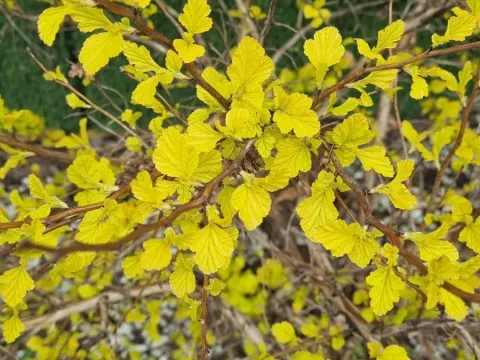
Ninebark
Physocarpus
Ninebark (Latin: Physocarpus) is a decorative woody shrub belonging to the Rosaceae family. Native to North America and parts of East Asia, this genus is widely recognized for its botanical resilience and ornamental foliage, which varies in color from deep purple to yellow-green.
What the section contains
 Amur ninebark
Physocarpus amurensis
Amur ninebark
Physocarpus amurensis
 Dwarf ninebark
Physocarpus alternans
Dwarf ninebark
Physocarpus alternans
 Mallow-leaved ninebark
Physocarpus malvaceus
Mallow-leaved ninebark
Physocarpus malvaceus
 Mountain Ninebark
Physocarpus monogynus
Mountain Ninebark
Physocarpus monogynus
 Pacific ninebark
Physocarpus capitatus
Pacific ninebark
Physocarpus capitatus
 Smooth-leaved ninebark
Physocarpus glabratus
Smooth-leaved ninebark
Physocarpus glabratus
 Spiraea-leaved ninebark
Physocarpus bracteatus
Star-flowered ninebark
Physocarpus stellatus
Spiraea-leaved ninebark
Physocarpus bracteatus
Star-flowered ninebark
Physocarpus stellatus
Ninebark
The plant is known for its exfoliating bark, which peels away in layers, giving it the common name "ninebark." It develops clusters of small, white or pinkish flowers in late spring, which are highly attractive to pollinators, followed by reddish seed pods.
Regarding climate and site requirements, Physocarpus is extremely adaptable. It thrives in full sun, which enhances the pigment of its colorful leaves, but it can also tolerate partial shade. It is exceptionally winter-hardy and resistant to urban pollution, making it an excellent choice for municipal landscaping.
The soil should be well-draining, as the plant does not tolerate waterlogged conditions that can cause root rot. While it prefers slightly acidic to neutral soil, it is forgiving of various soil textures, including heavy clay or light sandy types, provided there is adequate organic matter.
Agronomic management involves regular watering during the first year of establishment and mulching to retain moisture. Annual fertilization with a balanced NPK fertilizer in early spring supports vigorous growth and consistent foliage color throughout the growing season.
Iron chlorosis is a common physiological disorder, particularly in alkaline soils where iron becomes unavailable for root uptake. It is identified by yellowing leaf tissue while veins remain green; corrective measures include soil acidification and iron chelate applications.
Powdery mildew is a fungal threat that appears as a white, dusty coating on leaves, often prompted by high humidity and poor air circulation. Proper spacing between individual plants and judicious pruning are essential cultural practices to mitigate this infection.
Pests are generally not a major concern, although aphids can occasionally colonize succulent new growth during spring flushes. Infestations are typically managed with insecticidal soap or, in severe cases, contact pesticides, combined with healthy fertilization cycles.
Maintenance pruning is vital for the long-term health of the shrub. It is recommended to remove one-third of the oldest stems every few years to encourage new basal shoots, which ensures the plant remains dense and attractive rather than becoming sparse or overgrown.
By monitoring the environment and applying proper pruning techniques, gardeners can successfully cultivate ninebark for decades, maintaining its structural integrity and ornamental value in diverse landscapes.