
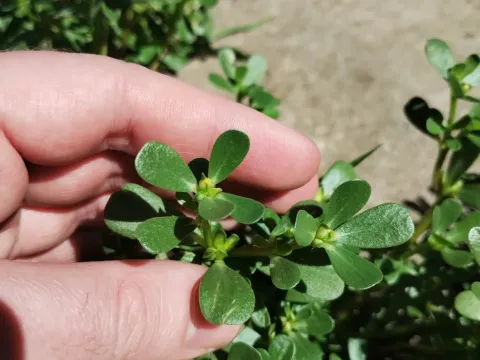
Common purslane
Portulaca L.
Common purslane (Portulaca oleracea L.) is an annual succulent herb belonging to the Portulacaceae family. It is a warm-season crop that requires soil temperatures of at least 15–18 °C for successful germination.
What the section contains


Common purslane
In temperate regions, direct seeding into the field is performed once the danger of late spring frost has completely passed. The seeds are extremely tiny, requiring shallow placement, barely covering them with a fine layer of soil.
For early production, growers may start seeds in trays under greenhouse conditions 3–4 weeks before the transplanting date. This method allows for a head start and ensures a more uniform plant stand in the field.
Row spacing is typically set at 30–40 cm to allow for efficient cultivation and weed control. Since purslane is a fast-growing crop, successional sowing every 2–3 weeks is recommended to maintain a continuous harvest throughout the summer.
The plant thrives in full sun, which is critical for maximizing its growth rate and flavor profile. In shaded conditions, the plant tends to become leggy and less productive.
Purslane is highly adaptable but performs best in well-drained, sandy loam soils with moderate fertility. It is particularly valued for its ability to grow in various soil types, provided they are not waterlogged.
Optimal growth occurs at temperatures between 20 °C and 30 °C. The crop is known for its heat tolerance and ability to store moisture in its succulent leaves, making it a resilient plant in hot climates.
While the plant is somewhat drought-tolerant, consistent soil moisture is necessary to achieve high-quality, tender, and crisp greens. Irregular watering can cause the leaves to become tough or overly acidic.
Cultural practices include regular weeding, especially during the seedling stage when the plants are not yet competitive. Once established, the dense mat of leaves typically suppresses most competing weeds.
Fertilization with nitrogen-rich sources after each harvest cycle encourages rapid regrowth. Proper soil aeration through light hoeing is also beneficial for root health and overall biomass development.
The yield potential of purslane is significant due to its fast maturation and the ability to produce multiple harvests from a single planting. Growers can expect to cut the crop several times during one season.
Average yields range from 1.5 to 3 kilograms per square meter per production cycle, depending on the intensity of management and cultivar selection. Selective breeding has resulted in varieties with larger leaves and delayed flowering.
Regrowth is stimulated by cutting the stems, which triggers lateral branching. This feature is exploited by commercial growers to maximize total output over the entire growing season.
Quality is paramount in yield assessment. High-quality harvests consist of succulent stems and vibrant green leaves. Proper timing of the harvest is essential to prevent the plants from becoming overly fibrous or woody.
The total yield is also influenced by light intensity and day length. Longer daylight hours in summer generally promote faster biomass accumulation, provided that water and nutrient requirements are adequately met.
Purslane is relatively resistant to major pests and diseases, but it can be susceptible to fungal pathogens like white rust or root rot, particularly in humid or overcrowded conditions with poor ventilation.
Aphids are the most common insect pests, clustering on the soft growing tips and underside of leaves. Early detection is necessary to prevent severe stunted growth and viral transmission.
Integrated pest management (IPM) practices, such as maintaining proper plant spacing and crop rotation, are effective in minimizing disease pressure. Chemical controls are rarely necessary and generally discouraged.
Slugs and snails may occasionally feed on young, succulent tissue, especially in damp environments. Physical barriers or traps are the preferred method for managing these pests in small-scale gardens.
Maintaining a clean field and removing debris after the final harvest helps break the life cycle of potential pests, ensuring a healthy environment for future crop rotations.
Harvesting usually begins 3 to 4 weeks after sowing, when the plants reach a height of 10–15 cm. The stems are cut about 2–3 cm above the soil surface to encourage the regrowth of new shoots.
The best time for harvesting is in the early morning when the leaves are turgid and cool. This practice significantly improves the shelf life and overall appearance of the harvested product.
Post-harvest handling is critical, as purslane greens are delicate. Rapid cooling to 2–5 °C is essential to maintain freshness. Proper refrigeration allows for a shelf life of approximately 3–5 days.
It is crucial to harvest before the plant initiates flowering. Once the plant produces buds, the leaves lose their tenderness, and the stems begin to lignify, making them unsuitable for fresh market sales.
For packaging, light-weight ventilated containers are recommended to prevent moisture buildup while protecting the delicate leaves from physical damage during transportation.