
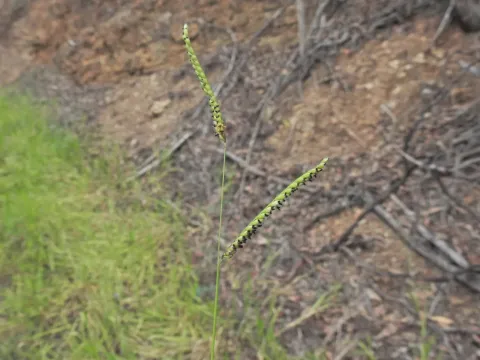
Urochloa
Urochloa
The sowing time for Urochloa is largely determined by the regional climate and the onset of the rainy season. It is best to sow when soil temperatures consistently reach 20–22 degrees Celsius and moisture levels are adequate to support germination.
What the section contains
 Browntop millet
Urochloa ramosa (L.) T. Q. Nguyen
Browntop millet
Urochloa ramosa (L.) T. Q. Nguyen
 Creeping signalgrass
Urochloa reptans (L.) Stapf
Creeping signalgrass
Urochloa reptans (L.) Stapf
 Hybrid Urochloa
Urochloa ruziziensis (R. Germ. & C. M. Evrard) Crins x U. brizantha (Hochst. ex A. Rich.) R. D. Webster
Hybrid Urochloa
Urochloa ruziziensis x Urochloa decumbens x Urochloa brizantha
Hybrid Urochloa
Urochloa ruziziensis (R. Germ. & C. M. Evrard) Crins x U. brizantha (Hochst. ex A. Rich.) R. D. Webster
Hybrid Urochloa
Urochloa ruziziensis x Urochloa decumbens x Urochloa brizantha
 Palisade grass
Urochloa brizantha (Hochst. ex A. Rich.) R. D. Webster
Palisade grass
Urochloa brizantha (Hochst. ex A. Rich.) R. D. Webster
 Para grass
Urochloa mutica (Forssk.) T. Q. Nguyen
Ruzi grass
Urochloa ruziziensis (R. Germ. & C. M. Evrard) Crins
Urochloa decumbens
Urochloa decumbens (Stapf) R. D. Webster
Para grass
Urochloa mutica (Forssk.) T. Q. Nguyen
Ruzi grass
Urochloa ruziziensis (R. Germ. & C. M. Evrard) Crins
Urochloa decumbens
Urochloa decumbens (Stapf) R. D. Webster
 Urochloa dictyoneura
 (Fig. & De Not.) Veldkamp
Urochloa dictyoneura
Urochloa dictyoneura (Fig. & De Not.) Veldkamp
 Urochloa glumaris
 (Trin.) Veldkamp
Urochloa glumaris
Urochloa glumaris (Trin.) Veldkamp
 Urochloa humidicola
 (Rendle) Morrone & Zuloaga
Urochloa hybrids
Urochloa hybrids
Urochloa humidicola
Urochloa humidicola (Rendle) Morrone & Zuloaga
Urochloa hybrids
Urochloa hybrids
 Urochloa mosambicensis
 (Hack.) Dandy
Urochloa mosambicensis
Urochloa mosambicensis (Hack.) Dandy
 Urochloa panicoides
 P. Beauv.
Urochloa panicoides
Urochloa panicoides P. Beauv.
 Urochloa plantaginea
 (Link) R. D. Webster
Urochloa plantaginea
Urochloa plantaginea (Link) R. D. Webster
Urochloa
In equatorial regions, seeding can occur throughout the humid season. Early sowing is often preferred as it allows seedlings to establish a robust root system before the peak heat of the dry season sets in.
Preparation of the seedbed is critical because Urochloa seeds are quite small. The soil must be fine and level to ensure uniform distribution, and seeds should not be buried deeper than 1–2 centimeters to allow for even emergence.
Pre-sowing treatments, such as scarification, are frequently employed to improve germination rates. Utilizing high-quality seeds with strong initial vigor is essential for establishing a dense and productive pasture from the very first season.
Sowing rates vary depending on the intended use: grazing pastures typically require higher seeding densities compared to seed production plots. Agronomists emphasize assessing soil fertility when planning the optimal sowing strategy.
Urochloa belongs to the Poaceae family and is a prominent tropical grass. It is highly valued for its exceptional drought tolerance and ability to maintain growth during periods of limited water availability.
The crop thrives in well-drained soils, ranging from sandy loams to heavier clays. While it can tolerate short periods of waterlogging, prolonged saturation of the root zone can be detrimental and lead to stand decline.
This grass is adaptable to various soil pH levels, often performing well in acidic, nutrient-poor tropical soils. Strategic application of nitrogen fertilizers significantly boosts vegetative biomass and overall protein content.
Abundant sunlight is a primary requirement for the photosynthetic efficiency of Urochloa. Shaded areas often result in stunted growth and a higher stem-to-leaf ratio, which reduces the nutritional value of the forage.
Optimal growth occurs at temperatures between 25 and 35 degrees Celsius. Below 10 degrees, the above-ground growth slows significantly, though the perennial root system typically remains dormant until conditions improve.
Urochloa is renowned for its high biomass production, with yields reaching 40–60 tonnes per hectare under favorable management. Its rapid regrowth allows for multiple cuttings per season, providing a reliable forage source.
Seed harvesting requires careful timing due to the natural tendency of the seeds to shatter upon maturity. With proper management, seed yields typically range from 200 to 500 kg per hectare, depending on the cultivar.
The feed value remains highest during the vegetative stage, with crude protein levels potentially reaching 12–16%. This high nutritional quality makes it an excellent option for beef and dairy cattle production.
As a perennial crop, Urochloa provides long-term economic benefits. When managed correctly through rotational grazing, a stand can maintain high levels of productivity for up to a decade.
Management factors such as soil nutrient levels and grazing pressure are the main determinants of yield. Overgrazing can deplete carbohydrate reserves in the roots, negatively impacting future growth cycles.
Fungal diseases, including various types of rust and leaf spots, are the primary biological threats to Urochloa. These issues are often exacerbated by high humidity and excessive planting densities.
Pests, such as spittlebugs, can damage the foliage and sap the vigor of the plants. Integrated pest management, focusing on resistant cultivars and timely monitoring, is the most effective way to address these challenges.
Ongoing breeding programs focus on developing varieties with higher resistance to local pathogens. Utilizing these improved hybrids helps reduce the necessity for chemical plant protection measures.
Nematodes can affect the root systems, especially in sandy soil conditions. Maintaining healthy soil biological activity through organic matter management can help suppress these subterranean threats.
Regular field scouting is essential to identify disease outbreaks at an early stage. Prompt intervention prevents the rapid spread of infections across the entire field and protects the overall forage quality.
Harvesting for green fodder is ideally performed during the booting stage, before flowering begins. This timing optimizes the balance between total biomass quantity and the digestible nutritional value for livestock.
The use of mower-conditioners is highly recommended for hay production, as they accelerate the drying process. Avoiding over-maturity is crucial, as fiber content increases rapidly once the plant reaches the reproductive stage.
Rotational grazing is the preferred management practice for pasture systems. By moving livestock between paddocks, the grass is given sufficient time to recover, maintaining its nutritional value and root health.
Seed harvesting involves specialized machinery settings to prevent grain damage during threshing. Efficient cleaning and post-harvest drying are mandatory to ensure seed longevity and viability during storage.
A cutting height of 5–8 centimeters should be maintained during harvest. This height protects the plant's growth points, ensuring fast regrowth and long-term stand survival in subsequent seasons.