
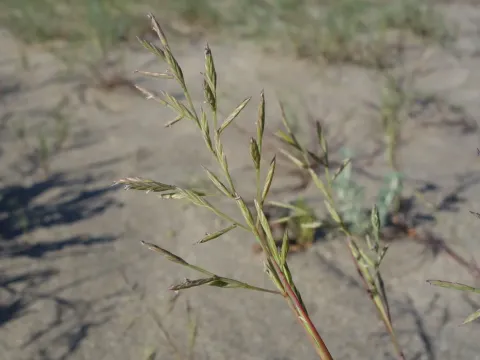
Cutandia
Cutandia
Cutandia is a genus of annual herbaceous plants belonging to the Poaceae family. These grasses have evolved to thrive in challenging environments where water availability is highly limited and unpredictable.
What the section contains


Cutandia
The native distribution of Cutandia covers the Mediterranean basin, the Middle East, and parts of North Africa. They are typically found in sandy soils, coastal dunes, and arid steppe environments.
Botanically, these plants are characterized by narrow leaves and panicle inflorescences. Being ephemerals, they complete their life cycle rapidly during the short spring rainy season to escape the intense summer heat.
The crop thrives in well-drained, sandy, and nutrient-poor soils. Cutandia exhibits remarkable salt tolerance, making it an interesting subject for studies on soil restoration in degraded or saline desert landscapes.
Regarding its utility, Cutandia is primarily managed as a forage resource for livestock grazing in semi-arid regions. It provides essential biomass when other vegetation is scarce, contributing to the biodiversity of rangelands.