
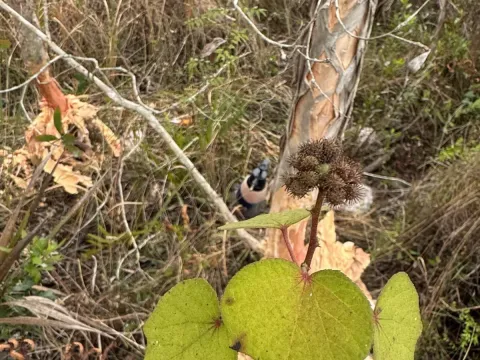
Urena
Urena
Sowing of Urena occurs during the spring period, when the soil temperature at the seeding depth reaches 15–18°C. The optimal time is defined by the establishment of consistently warm weather without the risk of late frosts, as the plant is highly sensitive to cold temperatures in the early stages of growth.
What the section contains

Urena
A row-based planting method is used with inter-row spacing of 30 to 45 cm, allowing plants to develop a tall and thin stem, which is essential for producing high-quality fiber. Seeding rates are calculated based on a target density of 300,000 to 400,000 plants per hectare.
Seeds are sown at a depth of 2–3 cm, as Urena seeds have moderate germination energy and require sufficient moisture in the topsoil layer for uniform emergence. It is crucial to ensure good contact between the seeds and moist soil by rolling the field immediately after planting.
In regions with prolonged rains, sowing is shifted to later dates to avoid waterlogging and subsequent seed rot in the soil. The crop shows active growth under high solar radiation, making early sowing in sufficiently moist conditions a prerequisite for forming a robust stand.
The growth intensity of Urena during the first 30 days after emergence is relatively low, making timely weeding and inter-row cultivation during this period critical to prevent weeds from suppressing the growth of young plants.
Urena is a heat-loving and moisture-loving crop belonging to the Malvaceae family, native to tropical and subtropical regions of the world. The plant requires air temperatures in the range of 20°C to 30°C for optimal vegetative development.
The crop has high soil moisture requirements: it needs abundant rainfall throughout its active growth period, which lasts from 100 to 150 days. However, Urena does not tolerate waterlogging, so fields must have good natural drainage.
The best yields are achieved on deep, fertile loam soils with a neutral or slightly acidic pH. It is essential to ensure high humus levels, as the formation of significant stem biomass requires intensive mineral nutrition, particularly nitrogen.
For industrial-scale cultivation, the light regime must be considered: Urena is a short-day plant, which significantly impacts the timing of flowering and seed formation. This dictates the choice of specific varieties for different latitudes.
For normal growth, the crop requires protection from strong winds that can cause lodging of the tall stems, which can reach heights of two meters or more. Agronomists recommend choosing plots sheltered from prevailing winds or using buffer strips of other crops.
The economic use of Urena is primarily focused on the extraction of bast fiber, which is physically and mechanically similar to jute. Dry fiber yield under intensive management can reach 1.5–2.5 tons per hectare, depending on soil fertility and agronomic practices.
Besides fiber, the crop provides a significant amount of biomass that can be used for cellulose and cardboard production. Green mass yields reach 30–50 tons per hectare, making Urena a promising candidate for the pulp and paper industry.
During harvest, an important indicator is the fiber recovery rate from the stem, which typically ranges from 15–20% of the dry stem mass. The recovery coefficient depends directly on the plant's growth stage, with the highest quality fiber obtained at the beginning of the flowering period.
Seed productivity of Urena is quite high: with proper management of seed plots, one can obtain up to 500–800 kg of seeds per hectare. For seed production, plants are left in the field until the seed pods are fully mature, a process that takes considerably longer than fiber production.
To maximize fiber collection, nitrogen fertilization is applied during the budding phase, which stimulates linear stem growth and increases overall crop productivity. Maintaining optimal plant density is key to preventing stem branching, which lowers the quality of the raw material.
Urena is susceptible to various pathogens, most notably fungal diseases like anthracnose and fusarium, which attack the root system and stems under high humidity conditions. Anthracnose infection causes dark spots on the stems, leading to fiber brittleness.
Among pests, various species of aphids and plant bugs cause the most damage by sucking juices from young leaves and shoots. This not only weakens the plant but also facilitates the spread of viral infections that reduce overall crop viability.
Urena can also be damaged by caterpillars of certain cutworm species that consume foliage and damage the apical bud, triggering unwanted branching. Pests can significantly reduce the volume of commercial product if biological or chemical control measures are not applied promptly.
Nematodes pose a serious threat when growing Urena in the same location for multiple years. To control soil-borne pests and infections, it is necessary to practice crop rotation, returning the crop to the same field no earlier than every 3–4 years.
To prevent the spread of diseases, seed material must undergo mandatory fungicide treatment before sowing. During the growing season, regular crop inspection is recommended, and if initial signs of pathogens appear, appropriate pesticides should be applied according to regulations.
Harvesting for fiber begins during the mass flowering phase of the plants. At this time, stems reach the necessary length and strength, and the fiber within them exhibits maximum elasticity and quality, which is critical for subsequent industrial processing.
Harvesting is performed mechanically using specialized mowers designed for tall herbaceous crops. Stems are cut as close to the soil surface as possible to avoid losing the valuable lower section where a significant portion of the yield is concentrated.
After cutting, stems undergo primary processing—soaking in water (water retting) or dew retting—during which the pectin substances binding the fibers are broken down. This stage requires strict control of temperature and duration to prevent fiber decay.
For seed production, harvesting occurs much later, once the seed pods turn brown and begin to split. The cut plants are bundled into sheaves and dried under shelters, followed by threshing using stationary threshers to maintain seed integrity.
After primary processing, the fiber is dried in the open air or in special drying chambers, cleaned of woody residues, and subsequently pressed into bales for convenient transport to processing facilities.