
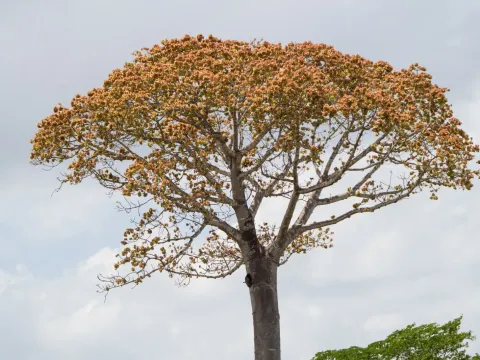
Cavanillesia
Cavanillesia
Cavanillesia is a genus of deciduous trees belonging to the Malvaceae family, native to tropical forests ranging from Panama to Peru and Brazil.
What the section contains


Cavanillesia
These trees are characterized by their barrel-shaped trunks, which are an evolutionary adaptation allowing the plant to store significant amounts of water during periods of drought.
To thrive, Cavanillesia requires warm tropical climates with high annual temperatures and deep, nutrient-rich soils that facilitate proper root development.
Good drainage is essential for the health of these trees, as they are highly susceptible to root rot if the surrounding substrate becomes waterlogged for extended periods.
The trees typically prefer open to semi-open spaces within the canopy, where they can receive adequate sunlight to support their rapid seasonal growth phases.
The wood of the Cavanillesia tree is remarkably lightweight and porous, often compared to balsa wood in terms of its physical density and industrial potential.
While not a traditional industrial crop, the tree has been utilized locally for crafting items that require light materials, although its commercial volume remains quite low.
Ecologically, the tree serves as a vital component of the tropical forest, providing food and shelter for various bird and insect species, thereby contributing to the forest yield.
Research into the species suggests that its growth rate can be substantial under optimal conditions, leading to the accumulation of significant amounts of woody biomass over decades.
Currently, the most important economic use remains in landscape architecture, where the tree's striking appearance makes it a popular specimen for large botanical gardens.
Fungal pathogens represent the primary disease threat, particularly those that target the root system during the transition between rainy and dry seasons.
Wood-boring insects are known to infest the trunks of damaged or aged trees, potentially leading to structural failure or secondary bacterial infections within the cambium layer.
Deforestation remains the most significant threat, as the conversion of tropical forest land into agricultural zones destroys the specialized habitats these trees require.
The lack of natural regeneration in disturbed forests poses a long-term risk to the survival of the species, as seedlings are often outcompeted by invasive scrub vegetation.
Increased frequency of forest fires in tropical regions, caused by changing weather patterns, continues to jeopardize populations of Cavanillesia in its native habitat.