
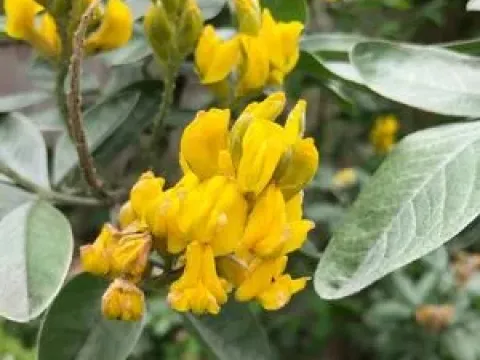
Ammopiptanthus
Ammopiptanthus
Ammopiptanthus is a rare genus of evergreen shrubs belonging to the Fabaceae family. It is known as one of the few broad-leaved woody plants capable of surviving in the harsh climate of Central Asian deserts.
What the section contains

Ammopiptanthus
The plant originates from the arid regions of China, Mongolia, and Kazakhstan. It has evolved to withstand extreme temperature fluctuations, ranging from scorching desert heat to extreme winter frosts.
This crop thrives in sandy, well-drained soils. Its root system is exceptionally robust, reaching deep into the soil to tap into limited moisture reserves, which also helps stabilize shifting desert dunes.
Cultivation requires minimal intervention. The key requirement is to avoid waterlogging, as the species is highly sensitive to root collar rot caused by poor soil drainage.
The primary utility of Ammopiptanthus lies in phytoremediation. It is widely used in environmental projects to combat soil erosion, protect farmland from encroaching sand dunes, and restore degraded arid landscapes.
In its native habitat, the plant is susceptible to various desert-dwelling insects, particularly locusts that can strip the shrub of its foliage during population outbreaks.
Fungal pathogens represent a threat primarily when the plant is grown outside its natural arid range, where higher humidity levels trigger root decay and stem lesions.