


Reference · Crops
Valerian
Valeriana L.
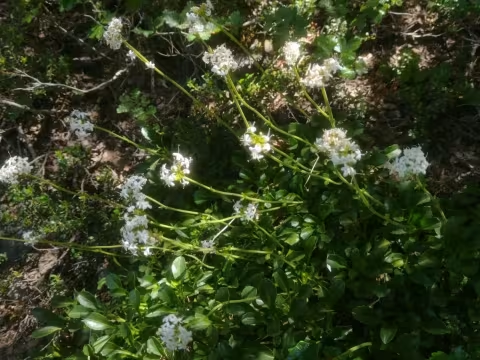
Valerian (Valeriana officinalis) is a perennial flowering plant in the Caprifoliaceae family. It is typically propagated by seeds, which can be sown in late autumn for winter stratification or in early spring after chilling treatments.
4
items
What the section contains
Marketplace
Products in this section · 12


Patrick C.E.
F.A.GAN Chemical Manufacturers Ltd. Israel, member
Herbicides
0
0
·
42
2 offers
89.14 €per pack
Buy

Trifluralin 480 g/L, herbicide
F.A.GAN Chemical Manufacturers Ltd. Israel, member
Herbicides
0
0
·
28
3 offers
9.89 €per 1 l
Buy

Triflurex 240 g.e., (Trifluralin, 240 g/l)
F.A.GAN Chemical Manufacturers Ltd. Israel, member
Herbicides
0
0
·
65
No offers
—
Details


Valerian
Seeds should be sown in rows with a spacing of 45–60 cm between them. Because the seeds are small, they should be planted at a shallow depth of approximately 1–2 cm to ensure proper germination.
During the first year, the plant focuses on establishing a vegetative rosette of leaves. This stage is crucial as the seedlings grow slowly and are easily overwhelmed by faster-growing weeds.
Thinning the seedlings is necessary once they develop two true leaves, leaving a space of about 15–20 cm between each plant to allow the root system to expand fully.
Success in the first year depends on maintaining clear rows, which reduces competition for light, water, and nutrients, setting the stage for strong growth in the second year.
Valerian thrives in fertile, well-draining soils with high organic matter content. Loamy soils with a neutral pH provide the best environment for the development of robust rhizomes.
The crop requires consistent moisture, especially during the first growing season. While it is generally hardy, supplemental irrigation is often needed during prolonged dry spells to ensure yields.
Balanced fertilization is beneficial, with an emphasis on phosphorus and potassium to encourage strong root development and winter survival. Nitrogen should be used carefully to avoid excessive leafy growth.
This species is highly cold-tolerant and survives winter conditions well in temperate climates. However, stagnant water in early spring must be avoided to prevent rhizome rot.
Choosing the right site is important; it is advisable to avoid fields previously occupied by crops that share similar soil-borne diseases, such as those in the Solanaceae family.
Commercial yields of dried valerian root typically range from 1,500 to 2,500 kg per hectare, depending on soil fertility, moisture availability, and the duration of the growing period.
The quality of the harvest is determined by the concentration of valerenic acid and essential oils. Harvesting at the correct physiological stage is critical to meeting industry standards.
Modern agronomic practices, including the use of improved seed varieties, have significantly boosted yields, making valerian a profitable enterprise for specialized herb growers.
Economic success depends on the efficiency of post-harvest processing. Drying the roots correctly ensures the preservation of volatile oils, which directly impacts the final market value.
Proper storage is essential to maintain the shelf life of the dried product. Keeping the roots in cool, dry, and dark conditions prevents degradation and loss of medicinal efficacy.
Powdery mildew is a common fungal threat, particularly in humid climates with poor air circulation. Proper spacing between plants helps to reduce the severity of these infections.
Root rot is a major risk on heavy or waterlogged soils. Ensuring good drainage is the most effective preventative measure against this common soil-borne disease.
Pests such as root aphids and wireworms can damage the subterranean parts of the plant. Monitoring and early intervention are necessary to protect the root yield.
Managing the surrounding area by removing weed hosts helps break the life cycle of various pests and diseases that might otherwise migrate to the valerian crop.
- Powdery mildew
- Fusarium wilt
- Wireworms
- Root aphids
Harvesting usually takes place in the autumn of the second year when the aerial parts of the plant begin to wither and die back, signaling that energy reserves have shifted to the roots.
Rhizomes are lifted from the soil using mechanical diggers, then cleaned thoroughly to remove any soil or stones. Washing is done using pressurized water to ensure the product is clean.
A brief period of wilting in the field or under sheds is practiced to initiate minor enzymatic changes, which are believed to enhance the characteristic scent and medicinal properties.
Drying must be performed in climate-controlled environments at temperatures not exceeding 40°C to preserve the volatile oils, which are highly sensitive to excessive heat.
The final product is inspected for color and aroma. High-quality valerian root has a distinct, strong odor and a uniform light brown color on the exterior, with a pale interior.