
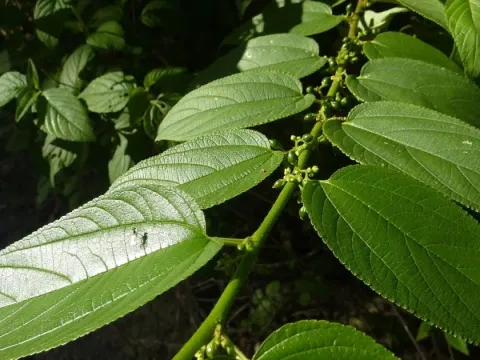
Trema
Trema
Trema, a member of the Cannabaceae family, is a rapidly growing tropical tree. Seeds are typically sown in nurseries at the beginning of the rainy season to ensure optimal moisture levels for germination.
What the section contains


Trema
The seeds exhibit high germination energy, though scarification or brief soaking is often recommended to speed up the process. Sowing is performed in prepared substrate at a depth not exceeding one centimeter.
Seedlings are transplanted to their permanent location three to four months after emergence, once they reach a height of 30–50 cm. Commercial plantations require specific spacing to accommodate the tree's rapid growth.
An optimal distance between trees is 2 to 3 meters. This density allows the canopy to close quickly, suppressing weeds and creating a favorable microclimate for root system development.
It is crucial to avoid planting during severe drought periods, as young trees require stable irrigation during the first weeks after transplanting to the open field.
The culture thrives in well-drained loamy or sandy soils. Trema adapts well to degraded lands, making it a promising candidate for reforestation projects and land restoration efforts.
As a light-demanding plant, Trema requires full sun exposure to achieve maximum productivity. High light intensity is essential for maintaining the rapid biomass accumulation characteristic of the species.
The temperature optimum for development ranges from 20 to 30 degrees Celsius. The plant is frost-sensitive, which limits its primary cultivation area to tropical and subtropical regions.
The plant prefers an annual rainfall of approximately 1000–1500 mm. While it demonstrates some tolerance to short dry spells, consistent hydration significantly improves wood quality.
The soil pH should range between 5.5 and 7.0. In more acidic soils, liming is recommended to ensure better nutrient availability and optimal growth conditions.
The primary economic value of Trema lies in its exceptional biomass accumulation rate. In favorable conditions, wood production can reach 15–20 cubic meters per hectare annually.
Harvesting cycles are short, with trees often reaching maturity for processing in just 5–7 years. This makes the species highly efficient for the paper and pulp industry.
Trema foliage is also utilized, as it contains significant protein levels, making it a valuable additive for animal feed and increasing the overall revenue of the plantation.
Seed yield varies depending on the tree's age and light exposure, with mature trees beginning to fruit actively by their third or fourth year of life.
Integrating modern fertigation systems allows for an additional 20–30% increase in yield by providing precise nutrient delivery throughout the plant's active growth phases.
The tree is generally resistant to many common forest diseases, but high humidity may lead to fungal leaf spots. Regular monitoring of the plantation is advised for early detection.
Insect pests, such as leaf-eating caterpillars or weevils, may cause damage to young shoots. Biological insecticides are recommended for localized treatment when infestations occur.
Root rot can develop in areas with poor drainage and waterlogging. Prevention includes selecting sites with good filtration and carefully managing irrigation schedules.
Bacterial infections are rare but can affect weakened or stressed trees. Sanitation pruning and the removal of diseased specimens are essential to maintain plantation health.
Managing weed competition is critical during the initial growth stages, as weeds can serve as pathogen reservoirs and compete for essential soil nutrients.
Harvesting is conducted mechanically or with chainsaws, depending on the scale of operation. The dry season is considered the best time for harvesting to ensure easier transport.
Once felled, the trunks are cleared of branches and bark. Trema wood is known for its soft texture, which facilitates efficient processing into wood chips or lumber products.
Logistics must be well-coordinated to ensure that harvested raw materials are processed promptly, preventing degradation caused by high ambient temperatures and humidity.
Stumps are often left for coppicing, allowing for subsequent harvests without the need for replanting, which reduces operational costs for future cycles.
Harvested material is sorted by trunk diameter and routed for production into paper, cardboard, or composite building materials.