
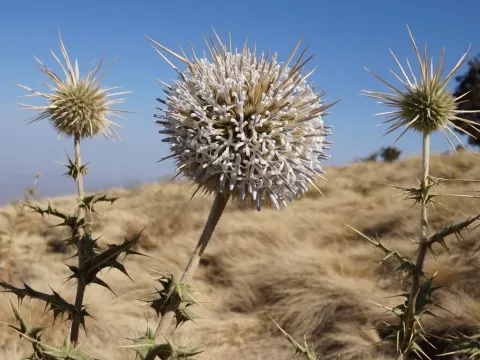
Globe thistle
Echinops L.
Globe thistle is a perennial plant that is best sown either late in autumn or early in spring. Autumn sowing allows the seeds to undergo natural stratification, which ensures more uniform germination at the beginning of the growing season.
What the section contains


Globe thistle
The optimal time for spring sowing is when the soil temperature reaches 6 to 8 degrees Celsius. Seeds are typically planted in rows with a spacing of 45 to 60 centimeters to provide adequate nutrition and growth area for each individual plant.
The sowing depth depends on the soil texture and should generally be between 2 and 3 centimeters. Placing seeds too deep can delay emergence or lead to the death of the seedlings, which is why precise machinery adjustment is crucial.
During the first year, the crop focuses its energy on developing a strong rosette of basal leaves and a deep taproot system. Intensive development of the flowering stalks and the subsequent blooming phase usually occur from the second year onwards.
The seeding rate is calculated based on seed quality and the planting method, averaging about 8 to 10 kilograms per hectare in broadcast or closely spaced drilling systems.
Globe thistle is a drought-tolerant plant from the Asteraceae family that adapts well to various climatic conditions in the temperate zone. It does not require intensive irrigation and can successfully withstand long dry spells without yield loss.
The plant prefers open, sunny locations, as shading causes the stems to stretch and significantly reduces overall productivity. Lack of sunlight hampers the formation of reproductive organs, which is critical for those growing it as a nectar source.
It is not demanding regarding soil composition, although it performs best on sandy or light loamy soils with a neutral pH. Heavy clay soils prone to waterlogging should be avoided as they may lead to root rot in the mature plants.
The crop possesses high frost resistance and can successfully overwinter without additional protection in most regions. Its well-developed root system allows it to access moisture from deeper soil layers, making it a viable crop for semi-arid areas.
The main agricultural use of the globe thistle is as a high-quality honey plant. In addition, it is recognized in the pharmaceutical industry as a natural source of echinopsine, which is extracted for various medicinal applications.
Common pests affecting this crop include various species of weevils and leaf beetles that can damage the leaf blades and flower heads. Regular scouting of the fields helps in identifying pest hotspots before they cause significant economic damage.
Under conditions of high humidity and poor air circulation, globe thistle can be susceptible to powdery mildew, which appears as a white coating on the leaves. Proper spacing and ventilation are the primary preventive measures.
Root rots are the most dangerous diseases associated with poor agronomic practices, especially on poorly drained ground. Adhering to a crop rotation cycle and returning to the same plot only after 4–5 years significantly reduces the risk of soil-borne pathogens.
Aphids can colonize young flower buds, sucking sap and stunting the plant's growth. In cases of severe infestation, the use of bee-friendly biological insecticides is highly recommended, given the plant's importance to pollinators.
Weed competition is only a significant threat during the first year of establishment when the plant is slowly developing its root system. Timely inter-row cultivation and weeding are essential during this early phase to ensure a productive field.