
Echinops ruthenicus
Echinops ruthenicus M. Bieb.
Description
Sowing dates
Echinops ruthenicus is a perennial herbaceous plant belonging to the Asteraceae family. In agricultural practices, sowing is typically performed in late autumn or early spring to allow for natural stratification and optimal germination conditions.
When sowing in spring, it is highly recommended to use seeds that have undergone cold stratification. The seeds should be planted at a depth of 2 to 3 centimeters, depending on the soil texture, ensuring good contact with the ground.
For commercial cultivation, row spacing is set between 45 and 60 centimeters. This distance provides adequate space for the deep taproot system to develop and facilitates mechanical weeding operations during the initial growth stages.
The seeding rate ranges from 6 to 9 kilograms per hectare, depending on the purity and germination rate of the seeds. Ensuring adequate soil moisture during the emergence period is critical for establishing a healthy plant stand.
During the first year, the crop primarily focuses on developing a basal rosette of leaves. Because growth is relatively slow during this period, keeping the fields free from competitive weeds is the primary concern for agronomists.
Growing requirements
This species is well-known for its drought tolerance and heat resistance, making it an excellent candidate for cultivation in arid or semi-arid climatic zones. It thrives in environments where many conventional crops would fail due to water stress.
Echinops ruthenicus prefers well-drained, fertile soils such as chernozems or loams. It does not tolerate waterlogging, as excessive soil moisture can lead to root rot and other physiological disorders.
The plant requires full sun exposure to maintain high productivity, especially regarding nectar secretion. Shaded areas lead to weak stem development and significantly reduce the quality of the harvested produce.
The crop is highly winter-hardy and requires no special protection against cold temperatures. It is perfectly adapted to the temperature fluctuations commonly found in temperate and continental climates.
Soil preparation includes deep plowing and the application of balanced NPK fertilizers, with an emphasis on phosphorus to support root development during the establishment phase.
Yield
The primary economic use of Echinops ruthenicus is its role as a high-performance nectar source for apiculture. It is considered one of the most efficient honey plants for mid-to-late summer periods.
The honey produced from this plant is highly regarded for its light color, delicate flavor, and slow crystallization process. Nectar yield can reach up to 500 kilograms per hectare under ideal growing conditions.
The seeds of the plant contain echinopsin, an alkaloid with pharmacological potential. This makes the crop valuable for the pharmaceutical industry, particularly for products targeting neurological and muscular support.
Seed yield varies from 5 to 12 quintals per hectare. Successful harvest depends on the presence of pollinating insects during the blooming phase to ensure proper fertilization of the flower heads.
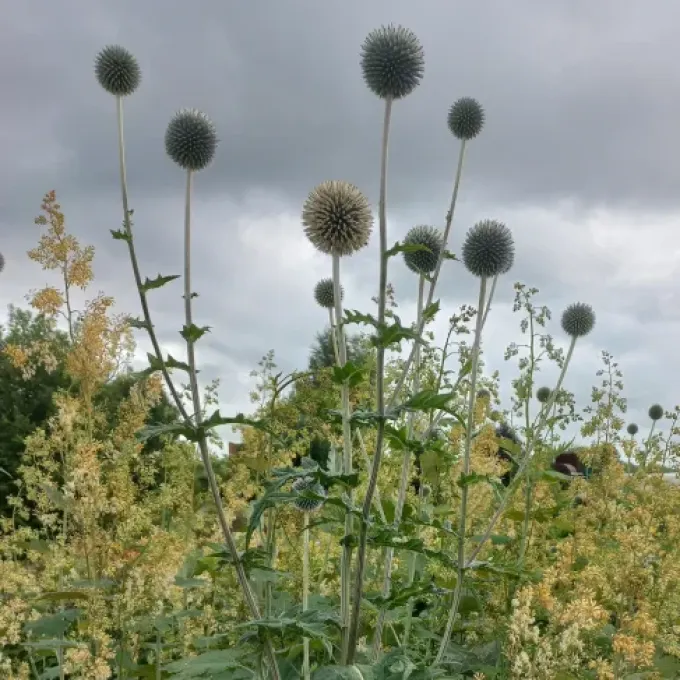
Beyond its agricultural utility, the plant serves as a popular ornamental species. Its striking spherical blue flower heads are used in floral arrangements and landscape design for their aesthetic appeal.
Main diseases and pests
Echinops ruthenicus is naturally resilient and displays high resistance to most common field crop diseases. Consequently, the need for chemical fungicide treatments is minimal compared to other agricultural crops.
In extremely humid conditions, some susceptibility to root diseases or powdery mildew may be observed. Good drainage and appropriate crop rotation are the most effective preventive measures against these issues.
Pest management focuses primarily on insects that damage the reproductive parts of the plant, such as seed-eating weevils. Regular scouting during the flowering period is necessary to determine if action is required.
Weeds are the main threat during the crop's establishment. Since the plant grows slowly in its first year, mechanical cultivation is essential to prevent weeds from outcompeting the young seedlings.
Pesticide application must be handled with extreme caution, as the plant is a critical forage source for bees. Any chemical intervention should be avoided during the peak blooming and nectar collection periods.
Harvesting
Harvesting for seed production occurs once the flower heads turn grey and the seeds become mature and hardened. This usually takes place in late summer or early autumn before natural shedding begins.
Mechanical harvesting with a combine is possible, provided the equipment is calibrated to handle the seeds gently. Proper speed adjustments are necessary to prevent the crushing of the delicate seeds.
Post-harvest cleaning is mandatory to remove impurities and chaff. The seed moisture content must be reduced to 12-14 percent to ensure long-term stability during storage in ventilated facilities.
For pharmaceutical applications, the plant material (seeds or flower heads) should be harvested at technical maturity and dried immediately in well-ventilated, shaded areas to preserve active compounds.
After the seeds are collected, the remaining biomass can be shredded and incorporated back into the soil, providing a small boost to organic matter content and promoting healthy field maintenance.