
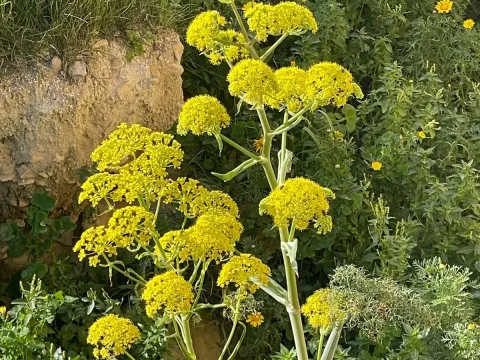
Ferula
Ferula L.
Sowing Ferula is typically performed in late autumn, as the seeds require a period of natural cold stratification in the soil to break dormancy and ensure germination.
What the section contains

Ferula
When sowing in the spring, it is essential to undergo artificial stratification for 60 to 90 days at low positive temperatures to achieve acceptable emergence rates.
Seeds should be planted at a depth of 2–3 cm depending on soil texture, ensuring proper contact with the soil for moisture absorption during the early stages.
Row spacing is usually maintained at 60–70 cm to facilitate mechanical cultivation and ensure adequate aeration for the plants as they develop.
As seedlings grow slowly in their first year, careful weed management is crucial for the establishment of a healthy crop population in the field.
Ferula is a perennial herb belonging to the Apiaceae family, native to the arid and semi-desert regions of Central and Western Asia.
The crop thrives in full sun and requires well-drained, sandy, or loamy soils, as it is highly sensitive to waterlogging, which often leads to root rot.
Climate requirements include high temperatures during the growing season and tolerance to significant diurnal temperature variations, typical of its native environment.
Although mature plants are drought-tolerant, consistent moisture is necessary during the initial establishment period to allow the root system to grow deep.
Field management requires regular weeding and soil loosening, which prevents soil crusting and helps in maintaining optimal conditions for root development.
The yield of Ferula is primarily determined by the biomass of the roots and the accumulation of secondary metabolites, such as gum resin, in the tissues.
Harvesting for commercial purposes usually begins from the 5th to the 7th year, when the plant reaches maturity and produces the highest quality resin.
Under optimal agronomic conditions, one can expect to harvest several hundred kilograms of raw root material per hectare for pharmacological or food applications.
The production of the specific gum resin, known as asafoetida, varies significantly by species and local climatic conditions during the flowering phase.
Since many Ferula species are monocarpic and die after flowering, planning for succession planting is necessary to maintain long-term crop productivity.
Ferula faces few major pest threats due to its potent chemical profile, yet fungal diseases remain a significant concern in managed field environments.
Root rot, triggered by poor drainage and excessive moisture, is the primary cause of crop loss and requires strict irrigation control.
Occasional infestations of aphids and mites can damage the leaves in spring, necessitating timely monitoring and appropriate pest management strategies.
Good agricultural practices, such as proper crop rotation and the use of healthy, disease-free seed stock, are essential to mitigate these risks.
- Improved drainage systems.
- Crop rotation every 7-10 years.
- Integrated pest management for sap-sucking insects.
Harvesting Ferula requires specialized techniques, particularly for the extraction of its aromatic gum resin, which involves precise cutting of the stem base.
The resin is collected by creating small incisions on the plant's root crown during the flowering season, allowing the latex-like substance to flow and solidify.
This labor-intensive process involves periodic collections, where the resin is scraped off, and fresh incisions are made to ensure continued flow.
For root-based medicinal use, harvesting is conducted in the autumn, when the aerial parts of the plant wither and energy is concentrated in the root.
Post-harvest processing involves cleaning the roots from debris, washing, and drying in a controlled environment to preserve the chemical potency of the resin.