
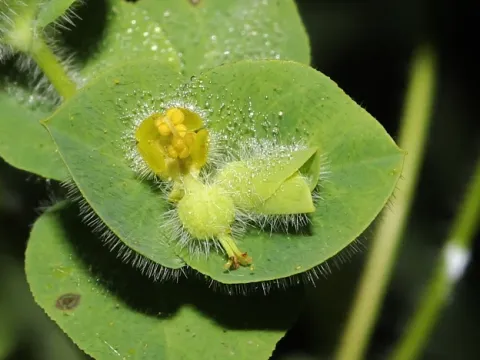
Hairy spurge
Euphorba hirsuta
Hairy spurge (Euphorbia hirsuta) belongs to the Euphorbiaceae family. It is a perennial herbaceous plant, often recognized in agricultural environments for its ability to persist in moist, disturbed habitats where it can become an invasive weed.
What the section contains
Hairy spurge
Native to parts of Europe and Asia, the plant is typically found in wetlands, near riverbanks, and in irrigated fields. It thrives in temperate climates where moisture is consistent throughout the growing season.
The plant requires nutrient-rich, moist, and well-drained soil types. While it prefers high soil moisture, it can adapt to various conditions, provided that the soil structure supports its extensive root system.
Botanically, it is identified by its stems covered in dense, stiff hairs and the presence of milky latex throughout the plant tissue. This latex contains complex chemical compounds that act as a natural defense mechanism against herbivores.
Management of this plant in an agricultural setting requires a focus on soil moisture regulation and integrated weed management practices to prevent the plant from establishing dominant colonies.
Like many Euphorbiaceae, Hairy spurge is susceptible to specific fungal pathogens, particularly those that thrive in dense foliage environments, such as powdery mildew or rust fungi, which can reduce its vigor.
Pests such as aphids and specialized coleopterans are commonly found on the plant. However, due to the toxicity of the milky sap, the plant remains relatively resistant to generalist herbivore attacks compared to other local flora.
Weed control efforts often fail when using standard mechanical cultivation alone, as the fragmented root systems can quickly regenerate. Systemic herbicides applied at the flowering stage are generally more effective.
Environmental management involves drainage optimization in waterlogged fields, which effectively reduces the plant's competitiveness against primary crops, as it relies on high soil moisture levels for rapid expansion.
Strategic crop rotation with aggressive, fast-growing cover crops is recommended to shade out the plant, effectively suppressing its photosynthetic capacity and hindering the development of new rhizomes.