
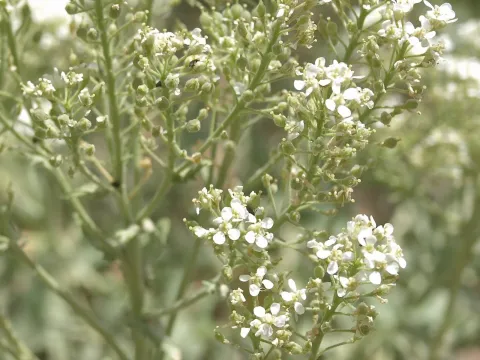
Hairy whitetop
Cardaria pubescens
Hairy whitetop (Cardaria pubescens) is a perennial herbaceous plant belonging to the Brassicaceae family. In agricultural settings, it is primarily categorized as a persistent, difficult-to-control root-sprouting weed rather than a crop.
What the section contains
Hairy whitetop
The plant originates from the arid regions of Central Asia and the Caucasus. Over time, it has established itself in various global regions, adapting well to diverse temperate and semi-arid climates.
Botanically, the plant is characterized by a deep and extensive root system. This allows the plant to thrive in nutrient-poor soils and resist drought by accessing water deep within the soil profile.
Environmental requirements for Cardaria pubescens include well-drained soils and high sunlight exposure. It is highly competitive in fallow fields, roadsides, and agricultural crops, where it outcompetes native flora.
While not a standard agricultural crop, it provides some value as a honey-producing plant during the spring season. However, its invasive nature usually leads farmers to prioritize its eradication rather than its preservation.
The primary threat posed by this plant is its aggressive vegetative reproduction. The roots can generate new shoots from tiny fragments, making mechanical tillage a potential cause of further spread if not managed correctly.
The plant acts as a reservoir for various pests, such as flea beetles and aphids, which can damage related crops like canola, cabbage, or mustard when they migrate from the weed patches.
Hairy whitetop is highly resistant to most local plant diseases, ensuring its continued dominance in areas where it has successfully established a foothold.
There are no significant natural enemies that effectively limit its population in conventional farming systems without the intervention of herbicides or intensive cultural practices.
- Integrated weed management (IWM) strategies.
- Systemic herbicide application.
- Crop rotation with high-density shading crops.
- Preventive measures to limit seed dispersal by equipment.