
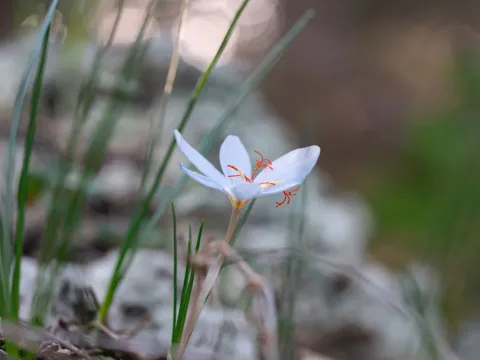
Crocus tournefortii
Crocus tournefortii
Crocus tournefortii is a perennial geophyte belonging to the Iridaceae family. Cultivation involves planting corms in late summer, typically August, when the plant enters its natural dormancy phase before the autumn growth cycle.
What the section contains
Crocus tournefortii
The corms should be planted at a depth of 7–10 centimeters in well-drained, porous soil. Ensuring adequate spacing of at least 10 centimeters allows for proper air circulation and reduces the risk of soil-borne pathogens infecting the bulbs.
For optimal results, the planting site should be located in full sun. This ensures the corms receive enough heat during the summer to ripen properly, which is essential for consistent blooming in the following season.
Vegetative propagation is achieved by separating the offsets (cormlets) that form around the parent corm. This process should be performed carefully during the dormant period to minimize mechanical damage to the root system.
Preparing the soil involves light tilling and the incorporation of sand or grit to ensure that water drains away from the corm, as this species is particularly sensitive to stagnant moisture.
This species requires specific environmental conditions, characterized by dry, hot summers and cool, moist autumns. It thrives in well-aerated soils with a neutral or slightly alkaline pH to prevent root rot.
Water management is the most critical aspect of care. Watering must be strictly limited to the growth phase and completely withheld during the summer dormancy to prevent premature sprouting or fungal rot.
While the species is hardy in Mediterranean-like climates, it requires protection from extreme frost in colder regions. Applying a layer of mulch during the winter can help insulate the soil and protect the delicate corms.
Fertilization should be handled with caution, focusing on potassium and phosphorus inputs. High nitrogen levels should be avoided as they promote lush vegetative growth that is more susceptible to disease and winter damage.
Sunlight requirements are absolute; any shade during the growing season will significantly reduce the number and quality of flowers, leading to weak, etiolated growth.
Fungal diseases, specifically Fusarium and Penicillium rot, are the primary threats to this culture. These diseases often emerge when bulbs are stored incorrectly or planted in soil that lacks proper drainage.
Rodents, including voles and mice, are known to consume the corms. Implementing protective measures such as wire mesh baskets or trapping is often necessary in areas with high rodent populations.
Thrips and aphids can infest the plants, causing damage to the developing leaves and buds. Regular inspection and the application of insecticidal soaps or systemic pesticides are recommended for control.
Preventative measures include the proper curing of corms after they are dug up. They should be stored in a cool, dry, and airy environment until the next planting season to avoid the accumulation of moisture.
If viral symptoms appear, such as streaking on the petals, affected bulbs should be immediately removed and destroyed to prevent the spread of the virus via insect vectors.