
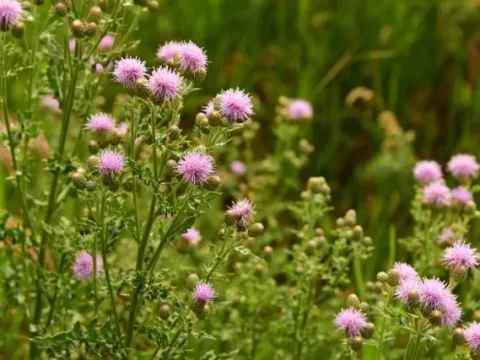
Creeping thistle
Carduus arvenis
Creeping thistle (Cirsium arvense) is a prominent perennial plant belonging to the Asteraceae family. It is recognized globally as a serious agricultural weed due to its aggressive growth habit and ability to infest large areas rapidly.
What the section contains
Creeping thistle
The botanical structure of the creeping thistle is characterized by a deep and extensive root system. Horizontal rhizomes can spread several meters, allowing the plant to propagate vegetatively by forming new shoots from adventitious buds.
The plant demonstrates high adaptability to various climate conditions, ranging from temperate regions to sub-arctic environments. It thrives in soils that are moist, fertile, and rich in nitrogen, often serving as an indicator of heavy or compacted soil.
It typically reaches heights of 1 to 1.5 meters, with distinctive spiny, lanceolate leaves and purple flower heads. It is dioecious, meaning male and female flowers are found on separate plants, which influences its pollination and seed production dynamics.
In farming, creeping thistle is considered highly competitive. It exerts pressure on crops by shading them out, competing for essential nutrients, and altering soil moisture levels, which ultimately leads to significant reduction in harvest quality and quantity.
Creeping thistle acts as a host for several diseases including white rust and various pathogens like Puccinia punctiformis, which can impact adjacent susceptible crops in the field.
A wide range of insects, such as the thistle lace bug and various weevils, feed on the plant, which is sometimes studied for the purpose of biological control programs.
Integrated weed management remains the most effective approach, involving a combination of cultural practices, such as competitive cropping, and mechanical removal of rootstocks.
Chemical control is most successful when translocated herbicides are applied at the rosette stage, ensuring that the active ingredients are transported into the extensive root system to kill dormant buds.
Continuous monitoring is essential because even small root fragments can survive soil disturbance and re-establish a patch within a single growing season if not properly managed.