
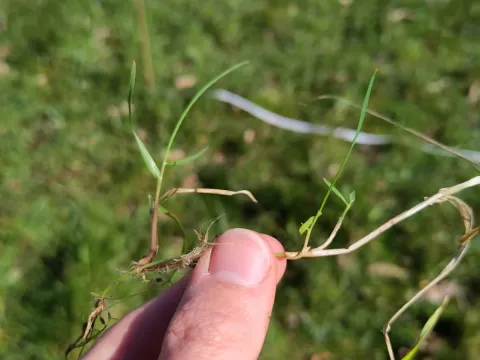
Creeping bentgrass
Agrostis palustris
Creeping bentgrass belongs to the Poaceae family. It is a perennial, cool-season grass known for its aggressive growth habit through stolons, which are above-ground stems that root at the nodes to form dense mats.
What the section contains
Creeping bentgrass
The ideal time to seed is during early spring or late summer when temperatures are moderate. Because the seeds are extremely small, they require a very fine, firm seedbed for successful germination.
Seeding rates are typically low, often ranging from 0.5 to 1.5 grams per square meter. It is essential to keep the surface consistently moist for the first several weeks until the seedlings are well-established.
Bentgrass establishes quickly if provided with proper moisture and nutrients. It fills in gaps efficiently, creating a seamless and uniform surface that is highly valued in professional turf management.
Once established, the grass spreads rapidly via its stolons, which helps in self-repairing damaged areas on the lawn or golf green, maintaining the integrity of the turf cover.
This grass thrives in moist, well-drained soils and requires significant amounts of water to maintain its health. It is particularly well-suited for regions with cool, humid climates.
It prefers full sun exposure to maintain its dense, fine-textured growth. While it has some tolerance for partial shade, its quality usually decreases compared to specimens grown in full sunlight.
Maintenance involves very low mowing heights, often between 3 to 15 mm, which is why it is the standard choice for golf course putting greens. Frequent mowing stimulates lateral growth.
Regular fertilization is necessary to support high-density growth. Nitrogen application should be carefully managed to prevent excessive lush growth that might become susceptible to fungal infections.
Aeration and top-dressing are crucial maintenance practices for creeping bentgrass to prevent thatch accumulation and improve oxygen flow to the root zone, ensuring long-term turf vitality.
Dollar spot is a prevalent fungal disease that affects creeping bentgrass, appearing as small, silver-dollar-sized necrotic spots, especially during periods of high humidity and moderate temperatures.
Brown patch and Pythium blight are other common threats, particularly when the grass is under stress from excessive heat, humidity, or poor air circulation around the turf canopy.
Insect pests such as grubs can cause significant damage by feeding on the roots. Early detection and treatment are necessary to prevent large patches of the turf from dying off.
Integrated Pest Management (IPM) is recommended, focusing on cultural practices such as dew removal, proper irrigation scheduling, and balanced nutrient management to reduce disease risk.
When chemical intervention is required, systemic fungicides or targeted insecticides are applied to manage outbreaks while minimizing impact on the overall health of the turf ecosystem.