
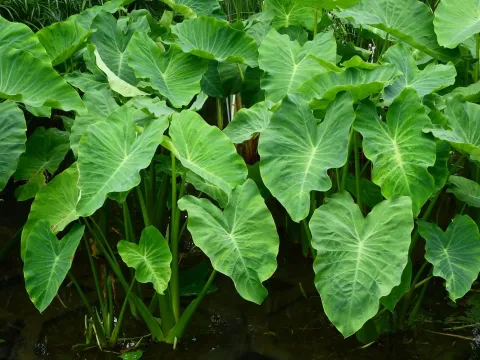
Indian taro
Colocasia indica
Indian taro, a member of the Araceae family, is a perennial tropical herbaceous plant. In commercial agriculture, the planting process usually begins in the spring when soil temperatures consistently stay above 20°C.
What the section contains
Indian taro
Planting material consists of tuber fragments or whole small rhizomes, which are placed in pre-prepared ridges or furrows. The optimal planting depth is 10–15 centimeters, which protects the tubers from dehydration and encourages rapid root development.
When grown in protected environments or regions with specific monsoon seasons, planting dates are timed to coincide with the start of the active growing season. Ensuring a moist substrate during the initial phase is critical, as the plant is highly sensitive to water stress shortly after sprouting.
Spacing between plants should be at least 60–80 centimeters. This distance is necessary due to the large leaf size and the need for adequate air circulation to prevent stagnant conditions that promote disease.
In temperate climates, the crop is cultivated as an annual. Growers plant pre-sprouted tubers only after the risk of frost has passed, ensuring that the harvest is completed before the onset of the cold season.
The plant has strict temperature requirements, thriving in a range of 25–30°C for optimal foliage development and tuber formation. Growth ceases below 15°C, and frost causes immediate destruction of the aerial parts.
Indian taro is a moisture-loving crop that prefers loose, organic-rich soils with a pH between 5.5 and 7.0. It adapts well to waterlogged areas or fields with high water tables, where other root crops would typically suffer from rot.
Despite its preference for moisture, the soil structure must allow for sufficient aeration of the root zone. Incorporating compost or well-rotted manure before planting is essential to achieve high yields.
Light intensity plays a significant role in development. In regions with intense solar radiation, the plant performs better in partial shade to avoid leaf scorch. However, excessive shade significantly reduces the rate of starch accumulation in the tubers.
Regular fertilization with nitrogen and potassium during the active growth phase is vital for increasing tuber weight. A balanced approach is required, as excessive nitrogen can lead to exuberant leaf growth at the expense of root development.
The average yield of Indian taro depends heavily on soil fertility, management intensity, and climatic conditions. Under optimal tropical conditions, yields can range from 15 to 25 metric tons per hectare.
The growing season until technical maturity ranges from 7 to 10 months. High productivity is achieved when the average weight of individual tubers reaches 500–800 grams.
Limiting factors for productivity include rainfall distribution and day length. In drought-prone areas, yields can be halved without the implementation of an efficient irrigation system.
The use of improved high-yielding varieties and intensive cultivation practices can significantly enhance output. Current breeding programs focus on developing varieties with shorter growth cycles and higher starch content.
Economic utility involves the consumption of tubers as a staple food after mandatory thermal processing, as well as industrial processing into starch. In some regions, the leaves are also utilized as a vegetable after proper preparation.
The most significant threats to Indian taro are fungal diseases, such as leaf blight and spot diseases, which proliferate in high-humidity conditions with poor ventilation.
Pests like aphids, spider mites, and various nematode species can severely reduce plant vitality. Nematode damage to the root system often facilitates secondary bacterial infections that lead to tuber rot.
- Leaf blight
- Root rot (Pythium)
- Aphids
- Spider mites
- Slugs and snails
Disease control relies on strict crop rotation and the selection of disease-free planting material. Disinfecting tubers before planting is a standard preventive measure against soil-borne pathogens.
Chemical protection is used only when damage thresholds are exceeded, as tubers can accumulate chemical residues. Integrated pest management, focusing on biological fungicides and natural predators, is preferred for sustainable production.
Harvesting begins when the aerial parts of the plant start to yellow and dry, signaling the end of nutrient translocation to the tubers. At this stage, metabolic activity slows down, which improves the storage stability of the crop.
Tubers are extracted using mechanical tools or manual labor with forks or shovels. It is critical to minimize mechanical damage to the tuber skin, as surface injuries provide entry points for pathogens during storage.
After harvesting, the tubers are dried briefly in a shaded area and cleared of soil residue. Sorting is then performed to remove damaged or diseased specimens, preventing the spread of rot within the storage facility.
Storage requires a cool, dry, and well-ventilated environment with temperatures maintained between 10–12°C. Temperatures below this range can cause chilling injury, while higher temperatures induce premature sprouting and moisture loss.
For long-term storage, tubers can be stored in crates layered with dry sand, which protects them from excessive moisture loss. Periodic inspections are necessary to remove decaying tubers and maintain the overall quality of the harvest.