
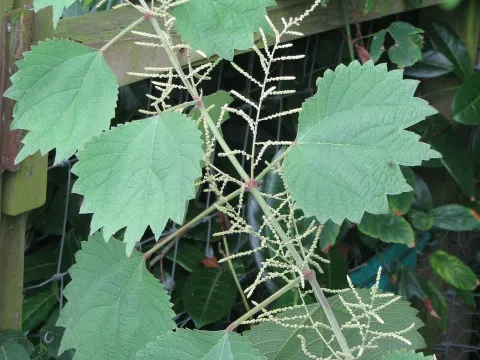
Boehmeria utilis
Boehmeria utilis
Boehmeria utilis, a member of the Urticaceae family, is a perennial herbaceous plant recognized for its production of high-quality bast fiber. It is a vital technical crop in various tropical and subtropical regions.
What the section contains
Boehmeria utilis
Planting typically begins in early spring, requiring warm soil temperatures for successful germination. Seeds are small and need precise shallow placement to ensure uniform development of the seedlings.
Industrial cultivation frequently employs vegetative propagation through root division or cuttings. This method ensures genetic consistency and provides a more predictable growth trajectory for the plantation.
Initial weed management is crucial for the success of the crop, as young plants are susceptible to competition. Establishing a clean seedbed is a standard practice to ensure healthy early development.
The optimal plant spacing is maintained to prevent excessive lateral branching. A dense, uniform canopy promotes the growth of straight, long stalks, which are preferred for industrial processing.
The crop demands a tropical or subtropical climate with consistent temperature levels throughout the growing season. It performs best in environments where extreme thermal fluctuations are minimal.
Fertile, well-draining loamy or sandy soils are essential for healthy plant growth. The species is highly sensitive to waterlogged conditions, which can lead to root degradation and stunted development.
Adequate soil fertility, managed through both organic and mineral fertilizers, is necessary to support rapid stem elongation. Balanced nitrogen levels are particularly critical for maximizing fiber production.
Continuous moisture supply is required, especially during the peak of the growing season. In areas with inconsistent rainfall, systematic irrigation schemes are often implemented to maintain high yields.
Protection against high-velocity winds is recommended to preserve the integrity of the stalks. Properly managed windbreaks contribute to healthier crops and superior quality of the harvestable fiber.
Fungal diseases, including leaf spots and root rots, represent the most significant threat to the health of the crop. These conditions are typically exacerbated by high humidity and poor airflow.
Insect pests, such as aphids and spider mites, can significantly impact biomass production. They feed on leaves and young shoots, weakening the plant and ultimately reducing fiber quality.
Integrated Pest Management (IPM) strategies, including crop rotation and the strategic use of biological controls, are highly recommended to minimize the reliance on chemical pesticides.
Maintaining proper plant density is a key agricultural practice to encourage natural ventilation within the fields, which helps in controlling the spread of fungal spores.
Monitoring for pest activity should be performed regularly, as early detection allows for targeted management and prevents large-scale outbreaks on the plantation.
The harvesting stage is critical for achieving the best fiber quality. It is typically conducted when the stalks have reached their peak length but before they become overly lignified.
Stalks are harvested by cutting them near the base of the plant. Advanced machinery is often utilized to handle large areas efficiently, ensuring minimal damage to the extracted raw material.
Decortication is the primary processing stage, where the fibrous bast is separated from the inner wood of the stalk. The efficiency of this process is heavily dependent on the freshness of the harvested stems.
Post-harvest handling involves thorough drying of the fibers to prevent degradation. Proper ventilation during this phase ensures the longevity and quality of the raw textile output.
Strategic scheduling of the harvest is essential for balancing agricultural productivity with the logistical requirements of the textile processing facilities.