
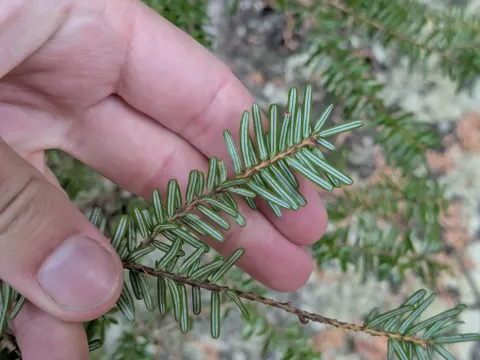
Siebold's hemlock
Tsuga sieboldii
Tsuga sieboldii, commonly known as Siebold's hemlock, is an evergreen conifer belonging to the Pinaceae family. Native to the mountain forests of Japan, this species is highly valued for its dense, dark green foliage and elegant, slow-growing habit.
What the section contains
Siebold's hemlock
Botanically, the tree is characterized by its short, shiny needles, which feature two distinctive white stomatal bands on their undersides. The bark is typically smooth on young specimens, becoming scaly and gray-brown as the tree reaches maturity over several decades.
Siebold's hemlock thrives in cool, moist, and humid climates. It requires well-draining, acidic soils that are rich in organic matter. Unlike some other hemlock species, it is somewhat less cold-hardy, preferring locations with protection from severe winter winds.
Choosing the right planting site is crucial for success. The tree performs best in partial shade, as direct, intense sunlight can scorch the needles and cause stress. Sufficient air circulation is also necessary to prevent foliage diseases common in dense, humid environments.
Maintenance involves consistent watering during dry spells, as the tree has shallow roots that are sensitive to drought. Applying a layer of mulch around the base of the tree helps retain soil moisture, suppresses weeds, and mimics the natural forest floor environment.
The main threats to Tsuga sieboldii are often environmental rather than pest-driven. Poorly drained soils can easily lead to root rot (Phytophthora), which is frequently fatal for this species. Proper drainage is the first line of defense against such pathogens.
Pests such as woolly adelgids and scale insects can infest the branches, sucking sap and weakening the tree's immune system. These infestations often lead to premature needle drop and yellowing of the foliage, significantly affecting the tree's aesthetics.
In hot and dry conditions, spider mites are a common nuisance. They thrive in low-humidity environments and can cause severe damage if left unmanaged, often appearing as small, dusty webs on the undersides of the needles during mid-summer.
Chemical control with systemic insecticides may be necessary for severe infestations. However, keeping the tree well-watered and healthy is the best way to ensure natural resistance to many secondary pests and fungal infections.
If fungal infections appear, such as needle blight or rusts, it is important to prune away infected foliage and apply appropriate fungicides. Monitoring the canopy regularly ensures that potential problems are caught before they become systemic.