
Cassytha filiformis
Cassytha filiformis L.
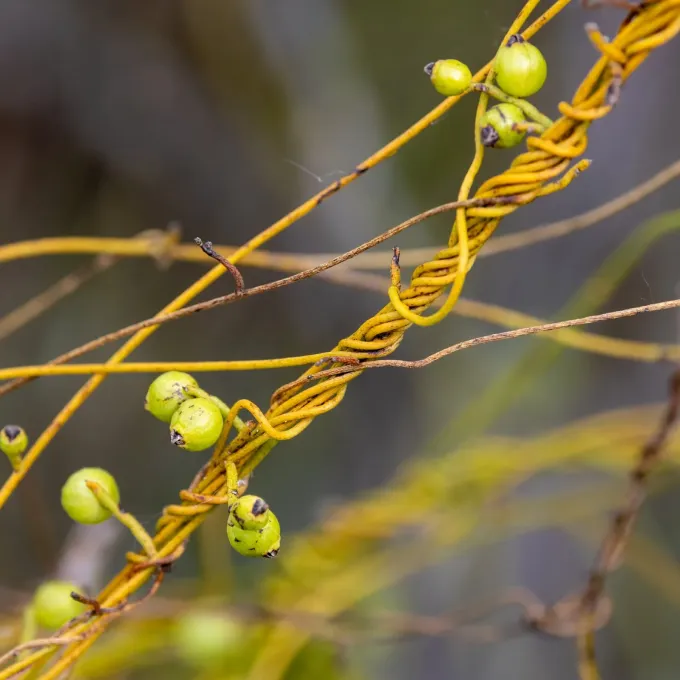
Description
Growing requirements
Cassytha filiformis is a remarkable member of the Lauraceae family that has evolved into an obligate stem parasite. Unlike most plants in its family, it lacks chlorophyll and relies entirely on host plants for water, minerals, and carbon compounds, which it extracts via specialized structures called haustoria.
The distribution of this species spans tropical and subtropical regions across the globe, including coastal areas of Australia, Africa, Asia, and the Americas. It thrives in sunny environments where it can easily access various host species, frequently forming dense, tangled mats over the canopy of shrubs and trees.
Morphologically, the plant appears as a mass of thread-like, yellowish-green or orange stems that wrap around the host. The root system is transient; it serves only to anchor the seedling initially, after which the plant becomes entirely dependent on the host, losing its terrestrial root connection permanently.
Climatic requirements are strictly tropical, as the species is highly sensitive to frost and low temperatures. It requires high humidity and year-round warmth to support its continuous vegetative growth, which allows it to spread aggressively across sensitive ecosystems and plantations.
In agricultural contexts, Cassytha filiformis is viewed strictly as a noxious weed that exerts significant stress on host plants. By diverting nutrients from crops, it stunts growth and reduces harvest yields, making it a target for rigorous management and quarantine practices to prevent its spread.
Main diseases and pests
Management of this parasite is primarily mechanical, involving the removal and destruction of the infected stems. Chemical control is notoriously difficult, as any herbicide applied to kill the parasite carries a high risk of causing severe phytotoxic damage to the supporting crop host.