
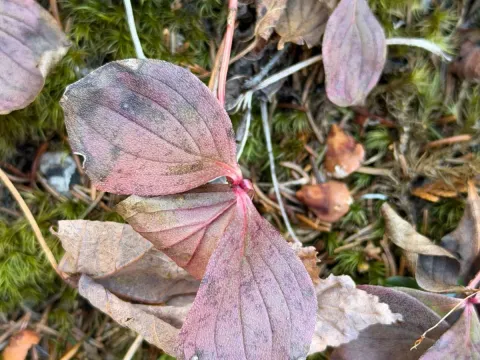
Canadian bunchberry
Cornus canadensis
Canadian bunchberry (Cornus canadensis) is a low-growing, rhizomatous herbaceous perennial belonging to the Cornaceae family. Unlike the well-known tree forms of the genus, this species serves as a creeping groundcover, rarely exceeding 20 centimeters in height, and is highly valued for its creeping habit.
What the section contains
Canadian bunchberry
The plant originates from the cool woodland regions of North America and parts of Asia. It thrives in temperate climates, naturally occurring in coniferous and mixed forests where it colonizes areas with moist, acidic soil and high levels of organic matter accumulation.
Successful cultivation requires specific environmental conditions, primarily protection from direct, intense sunlight and high temperatures. The ideal site is a shaded or partially shaded location that mimics the forest floor environment, ensuring the roots remain cool and consistently moist throughout the growing season.
Agronomic management focuses on moisture retention and soil amendment. Incorporating peat moss or compost into the planting site is essential, while applying a layer of acidic mulch, such as pine needles, helps suppress weeds and maintains the required soil acidity level for optimal growth.
In terms of хозяйственного (utilitarian) use, it is a premier plant for woodland gardening and restoration. It is widely employed by landscapers to cover bare ground under tree canopies where traditional turfgrass would fail, providing year-round visual interest with its unique white bracts and red berries.
The main threats to the plant include fungal pathogens that flourish in environments with poor air circulation or waterlogged soil conditions. Leaf spots and root rots are common issues that occur when the planting density is too high or the site drainage is insufficient for the plant's needs.
Pests, particularly mollusks like slugs and snails, are frequent intruders that feed on the foliage during wet spells. Additionally, aphids may occasionally colonize the soft, new stems, requiring careful monitoring to prevent the spread of viral or fungal infections often associated with sap-sucking insects.