
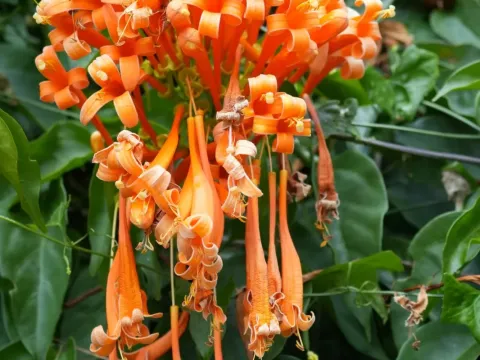
Pyrostegia
Pyrostegia
Pyrostegia, commonly known as the flame vine, belongs to the Bignoniaceae family. It is a vigorous, evergreen, woody climbing vine characterized by its long, tubular, bright orange-red flowers that appear in large, spectacular clusters.
What the section contains

Pyrostegia
The plant is native to tropical regions of South America, primarily Brazil. Due to its tropical origins, it requires frost-free conditions and thrives in warm, humid climates, making it an ideal choice for temperate and subtropical ornamental gardening.
Cultivation requires a location with full sun exposure to stimulate heavy flowering. The soil must be fertile, well-draining, and rich in organic matter to support the rapid growth rate of the vines during the active vegetative season.
The agrotechnical requirements include the installation of sturdy supports, such as trellises, fences, or pergolas. Pruning is essential after the flowering period to manage the size and shape of the vine and to encourage denser growth for the next season.
In landscaping, Pyrostegia is highly regarded for its ability to cover large surfaces quickly. It is used as a screening plant or a specimen climber, providing intense color during the blooming season in both urban and rural environments.
Common pests affecting Pyrostegia include aphids, scale insects, and spider mites. These pests typically congregate on the undersides of leaves or on succulent new growth, causing leaf curling and reduced vitality.
Fungal diseases, such as leaf spot and powdery mildew, may occur if the planting site lacks adequate air circulation or if humidity levels remain excessively high for prolonged periods, especially in shaded areas.
Root rot represents a significant physiological threat to the plant, usually triggered by waterlogged soils or heavy clay substrates that prevent proper oxygenation of the root system.
Proper nutrient management is necessary, as iron or magnesium deficiencies can lead to chlorosis, which manifests as yellowing leaves and impaired photosynthetic capability of the plant.
Effective management strategies involve regular inspections, maintaining proper spacing between plants to enhance airflow, and the use of targeted horticultural oils or systemic insecticides when infestation levels exceed economic thresholds.