
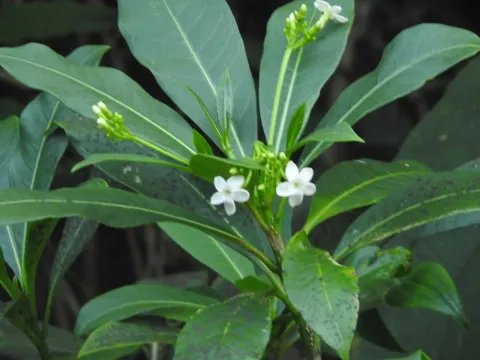
Rauvolfia
Rauvolfia
Rauvolfia is a perennial evergreen shrub, so large-scale propagation from seeds requires specific environmental conditions. Sowing is typically carried out in heated greenhouses or nurseries during late winter or early spring to ensure a sufficiently long growing season.
What the section contains

Rauvolfia
The seeds of this plant are known for their low germination rates and require pre-treatment, such as stratification or the use of growth stimulants, to improve success. Maintaining a constant substrate temperature of at least 25-28 degrees Celsius is essential for uniform emergence.
Once the seedlings reach a height of 10-15 centimeters, they are hardened off and transplanted into the open field, provided there is no further risk of frost. A spacing of 45x45 or 60x60 centimeters is recommended for optimal plant density.
Vegetative propagation via cuttings is considered a superior method for preserving the desired cultivar characteristics. Cuttings are taken from mature shoots and rooted under high humidity and shaded conditions.
Transplanting to the final site must be performed with great care as the root system is sensitive to mechanical damage. The optimal planting time is the onset of the rainy season, which maximizes the survival rate of the saplings.
Belonging to the Apocynaceae family, Rauvolfia naturally thrives in the tropical regions of Asia and Africa. The crop has high requirements for temperature stability, preferring warm conditions without sudden fluctuations.
Soil conditions should closely mimic a tropical forest floor, requiring loose, fertile, and well-aerated loams with a pH between 5.5 and 6.5. Waterlogging is strictly prohibited, as it leads to rapid root system decay.
The plant prefers plenty of light but requires light shading in its early growth stages to protect it from harsh, direct sunlight. When cultivated on open plantations, it is vital to provide windbreaks to protect the brittle stems.
Regular irrigation is critical, especially during active growth and root mass formation. Moisture deficiency slows down the accumulation of valuable alkaloids, which are the primary economic objective of this cultivation.
Organic fertilizers, such as compost or manure, are preferred for soil enrichment as they improve structure. Mineral fertilizers should be applied sparingly, with an emphasis on potassium-rich compounds to strengthen plant tissue.
The roots of Rauvolfia are the primary raw material used in the pharmaceutical industry due to their significant concentration of reserpine and other alkaloids. Yield depends heavily on the age of the plants and the strict adherence to agronomic standards.
In commercial plantations, root harvesting typically begins in the third year of vegetation, when the concentration of biologically active substances reaches its peak. At this stage, the total root yield per hectare can reach several tons of dried material.
The biological quality of the yield is directly related to the primary processing of the raw material immediately after harvesting. Roots must be thoroughly cleaned of soil, debris, and impurities before undergoing careful drying at controlled temperatures.
Under intensive management, plantations can remain productive for 5-7 years. However, after the plant reaches a certain age, alkaloid content begins to decline, necessitating the renewal of the planting stock.
The economic success of production is determined by chemical analysis of the roots before processing. Overall yield is also influenced by planting density and the correct application of base nutrients throughout the growth cycle.
Rauvolfia is susceptible to several fungal diseases, with root rot caused by poor soil drainage being the most significant threat. Proactive measures include crop rotation and the treatment of planting material with fungicides.
Leaf spot diseases are a common problem in regions with high humidity. Control strategies involve the timely removal of infected foliage and ensuring adequate ventilation within the plantation rows.
Pests such as aphids and spider mites can cause significant damage to young shoots in protected environments. The use of biological control agents and entomophages is the preferred method for managing these insect populations.
Root-knot nematodes represent a hidden threat capable of destroying a plantation in a short period. It is recommended to use resistant rootstocks and avoid planting on sites previously used for susceptible agricultural crops.
Timely monitoring of field conditions allows for the detection of disease outbreaks at early stages. Agronomic practices like weed control and soil mulching significantly reduce the risks of disease spread.
Harvesting Rauvolfia is a manual process, as the root system extends deep into the soil and is easily damaged by heavy machinery. Harvesting should be scheduled for dry weather to prevent the spoilage of the raw material.
The process involves careful loosening of the soil around the plant to ensure the entire root system is extracted without losing smaller, nutrient-dense rootlets. These smaller lateral roots often contain higher concentrations of active ingredients than the main taproot.
Once lifted, the roots undergo primary cleaning to remove soil, damaged parts, and woody stem residues. The purity of the raw material is a key quality parameter that determines its market value for pharmaceutical companies.
Drying is performed in specialized chambers or under ventilated sheds at temperatures not exceeding 50 degrees Celsius to maintain the stability of the alkaloids. Excessive heat can result in degradation and reduced pharmacological potency.
The finished raw material is sorted and packed into airtight containers or bags to prevent exposure to moisture and light. Proper storage ensures the preservation of the chemical profile until processing occurs.