
Salvinia sprucei
Salvinia sprucei
Description
Growing requirements
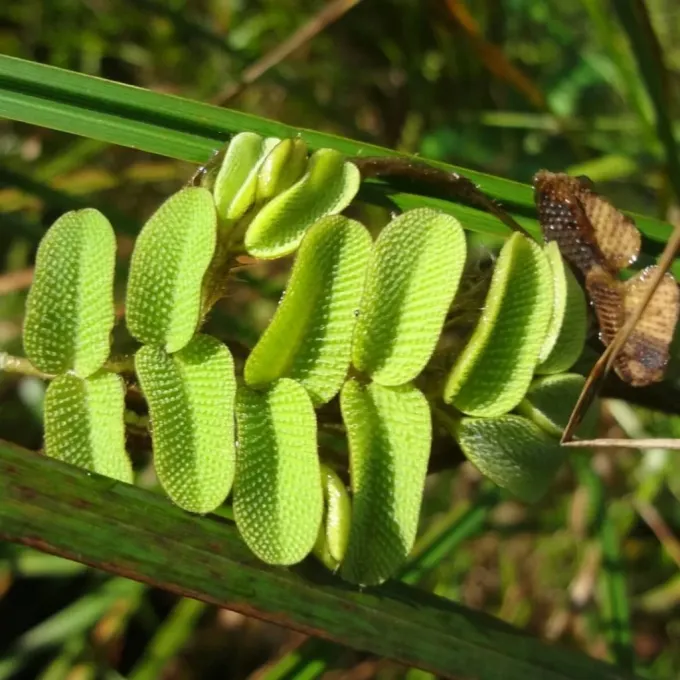
Salvinia sprucei is a floating aquatic fern belonging to the Salviniaceae family. It is recognized for its specialized leaf structures, which are covered in complex hairs that repel water, ensuring the plant remains afloat even during heavy precipitation events common in its native habitat.
Originating from the tropical regions of South America, this species thrives in warm, humid climates. It requires consistent water temperatures between 22 and 29 degrees Celsius to maintain active vegetative growth. It is primarily found in slow-moving streams, ponds, and wetlands where water stagnation promotes colonization.
In terms of aquatic requirements, Salvinia sprucei prefers nutrient-rich waters with a neutral to slightly acidic pH level. It is highly sensitive to water quality and can act as an indicator of excess nitrates, rapidly expanding its coverage when nutrients are abundant in the environment.
Light exposure is a critical factor for the healthy development of this fern. While it requires bright, indirect light for optimal photosynthesis, excessive direct sunlight can occasionally cause leaf damage. Providing sufficient space for the plant to spread is essential, as overcrowding limits gas exchange.
Agronomic management of this species involves monitoring the population density to prevent total surface coverage. Because it reproduces vegetatively through fragmentation, even a small section of the plant can rapidly multiply, necessitating careful management in controlled aquatic systems.
Yield
The biomass of Salvinia sprucei is valued in sustainable agriculture as a component for compost and as a medium for phytoremediation. Its ability to absorb heavy metals and excess minerals makes it a functional tool for cleaning wastewater before it is reused in irrigation systems.
Harvesting
Harvesting is performed mechanically using surface nets or skimming equipment. Because of its rapid growth rate, frequent harvesting cycles are required to keep the plant population in check and ensure the consistent production of biomass, while preventing the unintended spread of the species into local ecosystems.