
Miyabe willow
Salix miyabeana Seemen
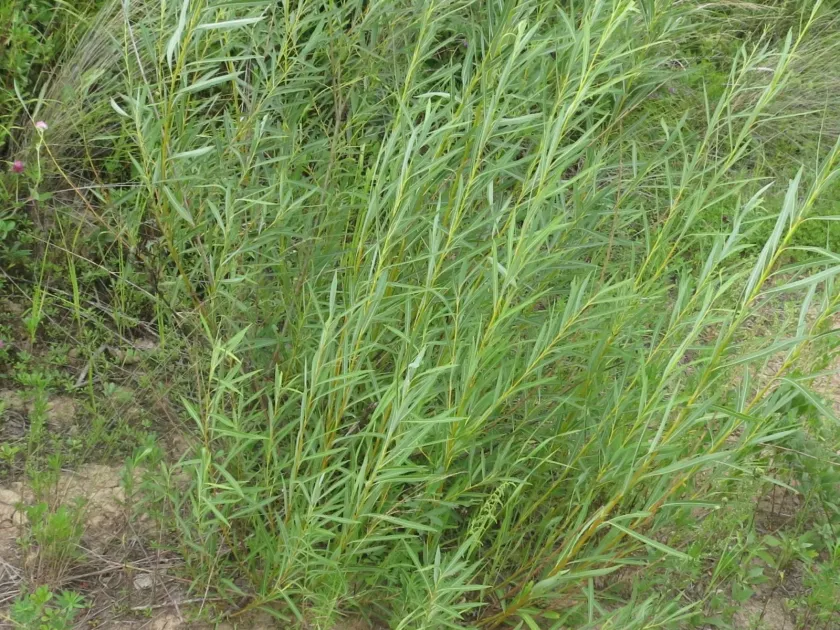
Description
Sowing dates
The planting of Salix miyabeana is primarily carried out via vegetative propagation by planting cuttings into prepared soil. The optimal time for planting is early spring, once the ground has thawed but still retains high moisture levels, which is critical for root establishment.
Prior to planting, cuttings 20–25 cm in length are soaked in water to activate internal root system development processes. It is essential to ensure that the buds on the cuttings are facing upwards and that the cutting itself is buried in the soil to at least two-thirds of its total length.
For industrial plantations, a double-row planting scheme with wide spacing is utilized. This allows access for specialized equipment for plantation maintenance and subsequent mechanized harvesting of the biomass crop.
Planting density typically ranges from 15,000 to 20,000 cuttings per hectare. This approach helps minimize competition between plants for sunlight and nutrients, ensuring uniform biomass growth.
After planting, it is crucial to provide abundant irrigation, especially if the spring season is dry. During the first few weeks following rooting, the plants are particularly sensitive to moisture deficiency and weed competition.
Growing requirements
Miyabe willow (Salix miyabeana) belongs to the Salicaceae family and is highly valued for its exceptionally fast growth rate. In its natural habitat, it is found in the Far East and Japan, preferring moist environments with rich alluvial soils.
The crop has high requirements for moisture availability and soil quality. It thrives best in loamy and sandy-loam soils with a neutral or slightly acidic pH, while avoiding areas prone to prolonged waterlogging.
The plant is well-adapted to climatic conditions, demonstrating high frost resistance in temperate latitudes. The optimal temperature range for active vegetation is between 18 and 25 degrees Celsius.
Agronomic practices require systematic control of plantation conditions, including weed management during the first year of growth. Herbicide use is permissible only in the early stages before canopy closure to avoid harming the plants.
To achieve maximum productivity, the application of mineral fertilizers, particularly nitrogen-based components, is recommended during the first half of the vegetation period to stimulate active shoot formation and leaf biomass development.
Yield
Miyabe willow is one of the most promising crops for obtaining renewable biomass. Plantation yield depends directly on the agronomic background, moisture levels, and the genetic potential of the specific clone or cultivar used.
On average, three years after plantation establishment, dry matter yields can reach 10–15 tons per hectare annually. With intensive cultivation methods, these figures can be higher due to optimized nutrient management.
The biomass obtained from this crop is characterized by a high calorific value, making it an ideal raw material for biofuel production. It leaves a minimal amount of ash after combustion, providing an environmentally friendly energy source.
Biomass accumulation occurs due to the plant's capacity for vigorous coppice regeneration. After each harvest, the stumps actively produce new shoots, allowing for a plantation lifespan of 15–20 years.
Industrial applications include the production of wood chips for heating plants, pellets, and the pulp and paper industry. Stable yields make Miyabe willow a reliable and sustainable energy resource.
Main diseases and pests
The main diseases affecting this crop are various types of rust and leaf spot, which become more active under high humidity and poor ventilation. Regular sanitary pruning helps reduce the pathogen load within the plantation.
Among pests, leaf beetles and weevils pose the greatest danger, as they can quickly defoliate a significant portion of the canopy. In such cases, preventive insecticide treatments are employed.
Damage caused by rodents can be critical for young plantations, particularly during the winter months. Creating buffer strips and installing traps around the perimeter of the field is recommended.
Pathogenic fungi can infect the bark, especially at mechanical injury sites after biomass harvesting. It is important to use sharp cutting tools to minimize jagged wounds that serve as entry points for infection.
For monitoring crop health, a weekly inspection of the plantation is recommended. Early detection of infection hotspots allows for localized threat management, preventing widespread pest or disease outbreaks.
Harvesting
Harvesting of Miyabe willow is carried out during the winter or early spring when stem moisture content is at its lowest and the plants are in their dormant phase. This facilitates logistics and raw material storage.
For mechanized harvesting, specialized combines are used to cut shoots just above the soil level and shred them into wood chips. The shredded material is easier to transport and dry efficiently.
After harvesting, it is vital that the surface of the stumps remains clean and is not subjected to excessive soil compaction by heavy machinery. This ensures high-quality regrowth of shoots in the following season.
The collected biomass is stacked in open areas for natural air-drying if it is intended for fuel use. Ensuring airflow through the stacks is important to prevent self-heating or mold development.
Harvest cycles are strictly regulated, usually set at 2–3 year intervals. Frequent cutting can exhaust the root system, whereas delayed harvesting leads to overly thick stems, which complicates industrial processing.