
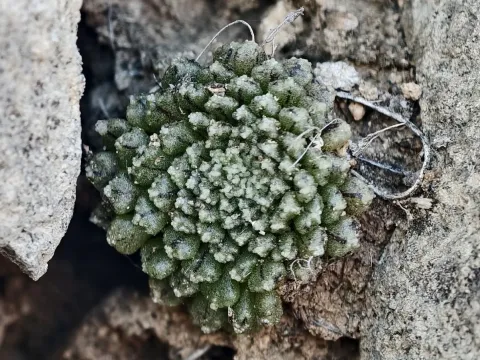
Monanthes
Monanthes
Propagation of Monanthes in cultivation is most commonly carried out vegetatively by dividing mature clumps or rooting individual rosettes. The optimal time for this activity is spring or early summer, when the plant is in its active growing phase.
What the section contains


Monanthes
Seed propagation is used less frequently, primarily by breeders. Seeds are sown on the surface of a light substrate consisting of sand and peat without deep embedding, maintaining high air humidity under glass or plastic covers.
An essential condition for successful startup is temperature control: seed germination and cutting rooting should take place at a stable temperature of 20–24 degrees Celsius.
Once seedlings emerge or cuttings develop roots, the watering intensity is gradually reduced to acclimatize the young plants to arid environmental conditions.
Repotting of adult specimens is performed no more than once every 2–3 years, typically in spring, which allows for refreshing the soil mix and stimulating the development of the root system.
Monanthes belongs to the Crassulaceae family and represents a miniature perennial succulent native to the Canary Islands and the Cape Verde Islands.
The crop is highly photophilous: to ensure the formation of compact rosettes and intense leaf coloration, bright solar illumination is required, ideally with direct sunlight during morning and evening hours.
Soil requirements include excellent aeration and drainage, as stagnant moisture is detrimental to the root system. Specialized substrates for cacti with a high content of coarse sand or fine gravel are ideal.
The temperature optimum for vegetation is 18–25 degrees, but during the winter period, the plant requires a distinct dormant phase with temperatures lowered to 10–12 degrees to promote flower bud development.
Watering should be moderate during warm months and minimal during winter, allowing the soil ball to dry out completely between irrigation cycles, consistent with the plant's natural adaptations to drought.
The primary threat to Monanthes is excessive moisture, which leads to the development of fungal diseases such as root rot and phytophthora, causing plant tissues to soften and darken rapidly.
Among pests, mealybugs pose the greatest danger, as they infest the leaf axils, sucking sap and suppressing the plant's growth.
Spider mite infestation is also possible in conditions of low humidity and high temperatures, manifesting as light spots on the leaves and fine webbing.
Disease prevention consists of adhering to proper watering regimens, ensuring adequate ventilation, and regularly inspecting the plants for any signs of pest infestation.
If insects are detected, systemic insecticides should be applied, whereas in cases of root rot, immediate repotting is necessary, involving the removal of affected parts followed by fungicidal treatment.