
Massonia thunbergiana
Massonia thunbergiana
Description
Growing requirements
Massonia thunbergiana is a fascinating bulbous perennial belonging to the Asparagaceae family, native to the arid environments of South Africa. This species is highly specialized, having evolved to survive in regions with distinct seasonal rainfall patterns.
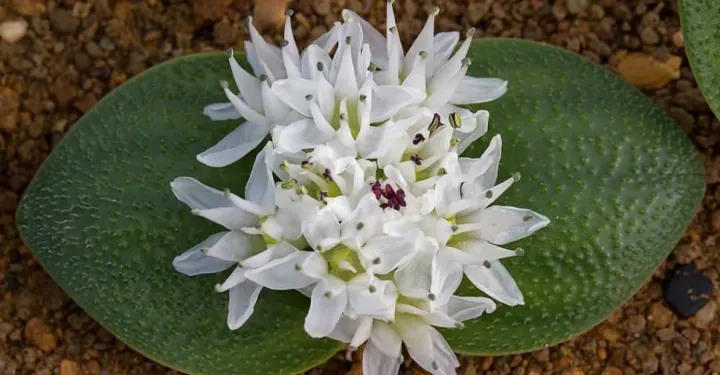
Botanically, it is characterized by two succulent leaves that spread flat against the ground, protecting the plant from drying winds and evaporation. Its inflorescence is a dense, brush-like cluster of flowers that appears directly between the leaves.
To cultivate this plant successfully, one must replicate its native Mediterranean-type climate. It enters a state of dormancy during the hot, dry summer months, at which point all watering must cease entirely to prevent bulb decay.
The substrate must be extremely well-draining, typically consisting of a gritty mineral mix with very little organic matter. Good aeration is essential to ensure that the roots do not sit in damp, stagnant soil during the cool winter growing season.
Temperature control is crucial: the plant prefers cool to moderate conditions (10–15°C) for active growth. Excessive heat during the winter growing phase will cause the leaves to stretch and lose their typical prostrate form.
Main diseases and pests
The primary threat to the health of Massonia thunbergiana is overwatering, which quickly leads to fungal infections of the bulb base and eventual rot of the entire specimen.
Pests such as mealybugs, particularly root-dwelling species, can severely damage the plant by feeding on the bulb tissue, often remaining undetected until the plant starts to decline.
Poor ventilation combined with high humidity levels increases the risk of grey mould (botrytis), which can rapidly spread across the succulent leaves if not addressed with improved airflow.
Regular inspection of the root zone during the dormant period is recommended to ensure that no dormant pests or decay processes are taking hold of the bulb.
Using sterile planting medium and avoiding contact between foliage and wet soil can significantly reduce the incidence of both pests and pathological plant diseases.