
Lithops olivacea
Lithops olivacea
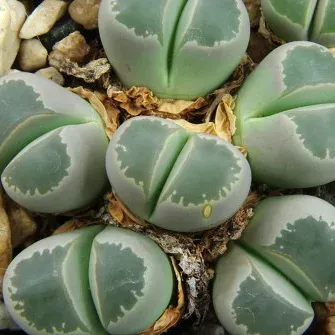
Description
Sowing dates
Sowing Lithops olivacea seeds is best performed during early spring. This timing allows the seedlings to benefit from increasing day length, which is crucial for developing strong, compact bodies rather than elongated, weak structures.
The substrate must be highly inorganic, consisting of fine sand and perlite. Surface sowing is mandatory, as the seeds are microscopic and require light for germination. Covering the seeds with soil usually prevents successful sprouting.
High humidity must be maintained during the first few weeks by covering the container with glass or plastic. However, once germination begins, regular ventilation is essential to prevent fungal infections, which are the most common cause of seedling mortality.
The optimal germination temperature ranges between 22 and 25 degrees Celsius. Under these conditions, germination typically occurs within ten to fourteen days, depending on the freshness of the seeds.
After the first molt, which usually takes several months, the seedlings can be gradually transitioned to the adult care cycle. This involves reducing water frequency and ensuring the plants receive bright, filtered sunlight to encourage root expansion.
Growing requirements
Lithops olivacea belongs to the Aizoaceae family and is native to the arid regions of South Africa. It is a succulent adapted to extreme heat and prolonged droughts, making it a challenging but rewarding crop for enthusiasts.
The most important environmental requirement is intense, direct sunlight. When grown indoors, these plants need a south-facing window or supplemental artificial lighting. A lack of light will result in the loss of their characteristic stone-like appearance.
The potting medium must be extremely well-draining, with almost no organic matter. A mixture of pumice, coarse grit, and a small portion of volcanic rock provides the necessary aeration for the roots to breathe and prevents rot.
Watering must follow a strict seasonal cycle. During the growing season, water only when the plant shows signs of thirst, such as slight wrinkling of the side leaves. During the winter dormancy, watering should cease almost entirely.
Lithops olivacea thrives in warm summer temperatures but requires a cool, dry resting period in winter. This temperature contrast is vital for initiating the natural molting process, where the old leaf pair is replaced by a new one.
Yield
The yield of this crop is measured by the successful cycle of leaf replacement and annual flowering. Healthy mature specimens will consistently produce new leaf pairs and, under optimal conditions, bright yellow flowers in autumn.
Lithops olivacea is primarily grown for ornamental purposes in private collections and specialized nurseries. Its olive-green color and smooth texture make it a popular specimen for rock gardens and miniature succulent landscapes.
Well-maintained clusters of Lithops can be highly productive in terms of biomass, as the plants slowly offset and multiply. This vegetative multiplication is a sign of a robust and long-living specimen within a controlled environment.
Seed production is possible with cross-pollination between genetically distinct individuals. Harvesting seeds is a critical task for those looking to expand their collection or engage in selective breeding for specific color traits.
Successful cultivation results in hardy, resilient plants that can tolerate years of growth in the same pot, provided the substrate remains porous and mineral-based, avoiding compaction and salt accumulation.
Main diseases and pests
The primary threat to Lithops olivacea is root rot caused by improper watering, specifically when the soil stays damp for too long. Once rot sets in, it quickly spreads to the leaf tissue, making the plant difficult to rescue.
Mealybugs are a significant pest, often hiding in the fissure between the two leaves. Because they are protected by the plant's structure, they can be difficult to eliminate without using systemic insecticides.
Spider mites can also be problematic if the humidity levels are too low and the air is stagnant. They cause scarring on the epidermis, which ruins the appearance and leaves the plant susceptible to secondary bacterial infections.
Prevention relies on strict adherence to the watering schedule and maintaining good air circulation. Periodically inspecting the plants for signs of pests or irregular soft patches is crucial for early detection and intervention.
- Use sterile mineral substrates.
- Apply systemic pesticides at the first sign of mealybugs.
- Ensure a strictly dry period during leaf molting.
- Avoid overhead watering to prevent moisture trapping in the fissure.