
Lithops karasmontana
Lithops karasmontana
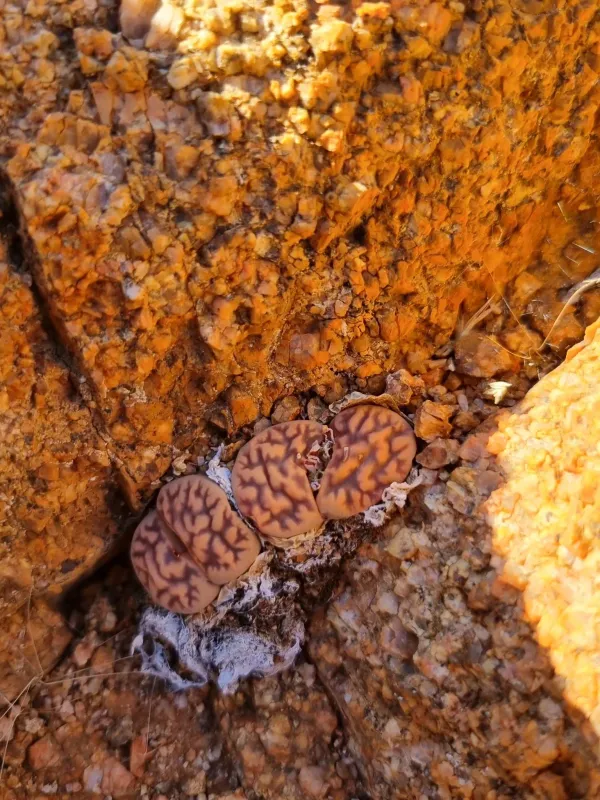
Description
Sowing dates
Sowing seeds of Lithops karasmontana should be performed in late winter or early spring to take advantage of the increasing daylight. A shallow tray filled with a sandy, well-draining substrate is ideal for germination.
Seeds are sown on the surface and lightly pressed into the soil. A thin layer of coarse sand can be applied to keep the seeds in place without burying them, as they require light to germinate effectively.
Maintaining a constant temperature of around 20–25 degrees Celsius is crucial. A plastic cover helps maintain the necessary humidity levels during the initial stages of seedling development.
Once the seedlings emerge, it is essential to gradually introduce ventilation. The cover should be removed carefully over several days to harden the young plants to the ambient atmosphere.
As this species is a slow grower, seedlings should remain in the initial seed tray for at least one full year before any attempts at transplantation are made.
Growing requirements
Lithops karasmontana belongs to the Aizoaceae family and is native to the arid rocky regions of Namibia. Its evolution has resulted in a body shaped to blend perfectly with its stony habitat.
High levels of solar radiation are mandatory for healthy growth. These plants require direct sunlight; otherwise, they will lose their characteristic compact form and exhibit etiolation.
The substrate must be primarily mineral-based. A mixture of pumice, perlite, and coarse sand provides the necessary aeration and prevents the water accumulation that leads to root rot.
Watering requires strict discipline: hydration should be minimal and aligned with the plant's natural growth cycle. It is vital to stop all watering during the winter dormancy period.
Good air circulation is an essential requirement. A stagnant environment promotes fungal infections, so placing the plants in a spot with constant airflow is highly recommended.
Main diseases and pests
Root rot remains the most common threat, usually caused by overwatering or poor drainage. Once rot sets in, the plant is often beyond saving, emphasizing the need for cautious watering.
Mealybugs are the most frequent pests, often congregating in the fissure between the two succulent leaves. Regular inspections with a magnifying glass can help identify them early.
Spider mites can also become an issue in environments with low humidity. They extract sap from the plant, leaving behind unsightly yellow spots on the surface of the living stone.
Root nematodes can cause unexpected decline. Utilizing sterilized soil mixes is the primary method for preventing infestation by these microscopic soil-dwelling pests.
- Avoid overhead watering to prevent leaf damage
- Ensure excellent drainage in all containers
- Use systemic pesticides for pest outbreaks