
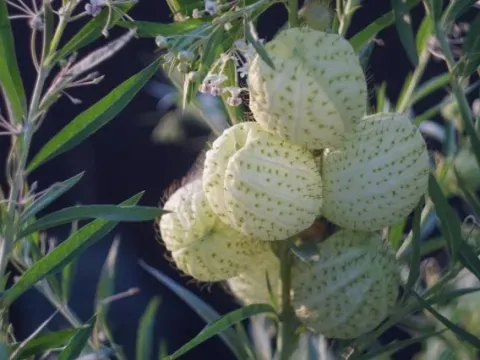
Gomphocarpus
Gomphocarpus R. Br.
Gomphocarpus belongs to the Apocynaceae family and is often cultivated as an annual in temperate climates. Seeds should be sown indoors in late February or early March to provide sufficient time for root system development.
What the section contains

Gomphocarpus
Seeds are sown in a light, nutrient-rich substrate at a depth of no more than 0.5–1 cm. Containers should be covered with plastic or glass to create a greenhouse effect, maintaining temperatures between 20–22°C to stimulate uniform germination.
Pricking out seedlings is performed after the first pair of true leaves appears. It is important to handle the roots with care, as the culture is sensitive to damage during transplanting.
Seedlings should only be planted outdoors once the danger of night frost has passed. Stable soil warmth is critical for Gomphocarpus, so planting in cold soil should be avoided.
Planting density depends on the purpose: for decorative cut flowers, plants should be spaced 30–40 cm apart to ensure adequate air circulation.
Originating from Africa, this culture has high light requirements. Gomphocarpus needs open, sunny areas protected from strong winds to thrive.
Soils must be well-drained, as water stagnation is detrimental to the plant's root system. Loose, sandy loam or loamy soils with a neutral to slightly acidic pH are optimal.
During active growth, the plant requires regular but moderate watering. Over-saturation of the soil must be avoided, as excessive moisture can trigger rot in the lower stem area.
To promote intense growth and the formation of high-quality follicles, fertilization with complex mineral fertilizers (low in nitrogen in the second half of the season) is necessary.
Climate adaptation: in regions with harsh winters, the plant does not survive outdoors, so it is often grown in pots and moved indoors before the onset of cold weather.
The primary pests affecting Gomphocarpus are aphids and spider mites. These insects multiply rapidly in hot, dry air, feeding on the juices of young shoots and leaves.
Excessive humidity in the soil and air can lead to fungal diseases such as root rot and powdery mildew. Prevention involves adhering to proper watering schedules and removing crowded shoots.
The biological features of the species include the presence of toxic milky sap. This is a natural defense against most pests but requires caution during agricultural tasks like pruning.
For pest control, systemic insecticides are recommended. In case of fungal infections, treatments with broad-spectrum fungicides are effective.
Regular inspection of the crop allows for early detection of infested areas. Removing diseased plants promptly prevents the spread of infection across the entire field.
The main value of this crop lies in its unusual fruits — inflated, pubescent follicles that are highly valued in floristry. Harvesting begins when the fruits reach their typical size and feel firm to the touch.
For dried flower arrangements, stems should be cut in dry weather. It is important to harvest before the fruits begin to open to prevent seed loss and maintain the decorative appearance.
After cutting, remove the lower leaves and hang the stems upside down in a dark, well-ventilated room to dry gradually.
When used in fresh bouquets, Gomphocarpus can last up to two weeks in water. The milky sap on the cut stem may cause skin irritation, so wearing gloves is recommended.
Agricultural use of this crop extends beyond ornamental design: in some regions, parts of the plant are studied as a potential source of specific fibers and biomass.